The Friends of the Wildflower Garden Inc.
Plants of the Eloise Butler Wildflower Garden
The oldest public wildflower garden in the United States
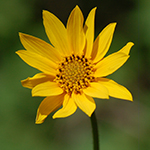
Common Name
Western Sunflower (Few-leaved Sunflower)
Scientific Name
Helianthus occidentalis Riddell subsp. occidentalis
Plant Family
Aster (Asteraceae)
Garden Location
Historical - not extant
Prime Season
Late Summer to early Autumn
Botanists agree with the amateurs that the sunflowers are very difficult to identify due to the need to look at microscopic differences and the fact that they hybridize. Western Sunflower is a native, erect perennial forb, growing from 2 to 5 feet high on stems that have very few small stem leaves. The stems are hairy, at least in the lower parts, and have reddish color tones or can be very reddish if they have full sun. Plants may sparsely branch in the upper half.
The leaves are of two types - basal and stem. Most leaves are basal, of varying shape from ovate to oblong, with bases tapering to a wing that extends partially down the long stalk. Basal leaves can be up to 7 inches long. The margins are entire to having small teeth. The underside has surface hair as does the margin and the leaves are rough to the touch. Surfaces are gland dotted. There are 3 main veins - the central midrib and two laterals that follow just inside from the leaf margin. The stem leaves are much smaller, opposite and rarely more than 4 pair, thus the alternate common name of "few-leaved." The very upper leaves may be alternate.
The floral array is sparse, consisting of one to several flower heads in a loosely branched cluster atop the stems.
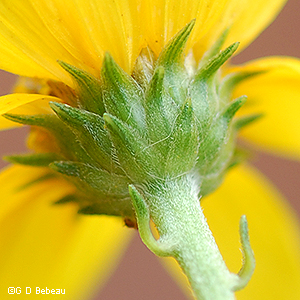
Flowers are composite with two types of florets: Ray florets and disc florets. The central disc has 50+ disc florets with yellow corolla tubes with 5 pointed lobes at the throat opening. These are bisexual and fertile with 5 stamens that have dark brown or black anthers with yellow appendages which tightly surround a single style. These florets are surrounded by 8 to 14 ray florets with yellow rays that are gland dotted on the back side. These are not fertile. The entire flower is 1-1/2 to 2 3/4 inches wide when open. Around the outside of the flower head are the phyllaries (floral bracts) which number 20 to 25 and are lanceolate in shape and the margins usually have fine hair if not the entire outer surface. They are short and stiff, with sharply pointed tips and those closest to the ray florets will be spreading outward when the flower opens.
Seed: Fertile flowers produce a dry cypsela, 3 to 4 mm long, that has two small awns. Seeds are dispersed by dropping or by the wind dispersion. Seeds weigh about 14,000 to the ounce and require 30 days of cold stratification for germination.
Subspecies: There are two - see notes at bottom of page.
Habitat: Western Sunflower grows from a root system of slender rhizomes which allow the plant to aggressively form plant colonies when grown in full sun in poorer soils. It requires full to at least half sun and does best in mesic to dry moisture conditions in loose sandy or loamy soils. It does not do well in richer soils.
Names: The genus Helianthus is from two Greek words, helios for 'sun' and anthos for 'flower.' The species occidentalis is from the Latin for 'western,' referring to this being a New World species. The author name for the plant classification - ‘Riddell’ refers to John Leonard Riddell, (1807-1865), American chemistry professor, botanist, writer, and medical doctor. He was born in Massachusetts, but most of his botanical observations were in the central states from Ohio southward. His important work was a “Synopsis of the Flora of the Western States” defined at the time as the territory from the Allegheny mountains to the Platte River in Missouri Territory. It was in great part a compilation. He later published Catalogus Florae Ludovicianae. He served as Adjunct Professor of Chemistry and Lecturer on Botany in the Cincinnati Medical College where he also received his M.D. He later became chair of the Chemistry Dept. in the Medical College of Louisiana (which then became the University of Louisiana), which position he held until his death. It was there he invented the binocular microscope. The plant genus Riddellia was named for him.
Comparisons: Difficult as sunflowers are to identity, this one, with the sparsely leafed stem, will not be confusing among sunflowers that have similar looking, but more plentiful leaves.
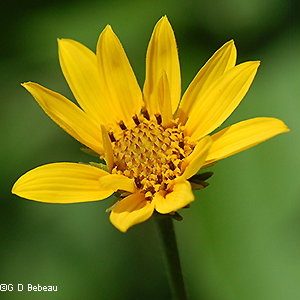
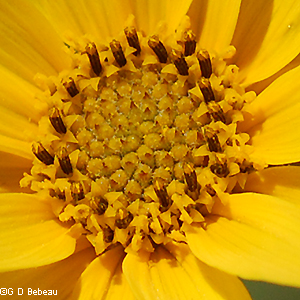
Above: Only the inner disc florets are fertile in Helianthus. Florets open toward the center of the disc.
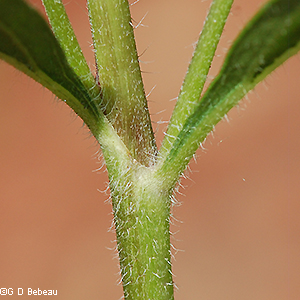
Below: The phyllaries are pointed and hairy, the inner ones spreading. Stems are hairy, at least in the lower half with reddish tones.
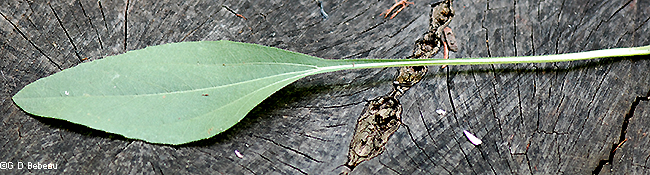
Above and below: The basal leaves are long-stalked and much larger than the stem leaves. Note also a few fine teeth on the margins.
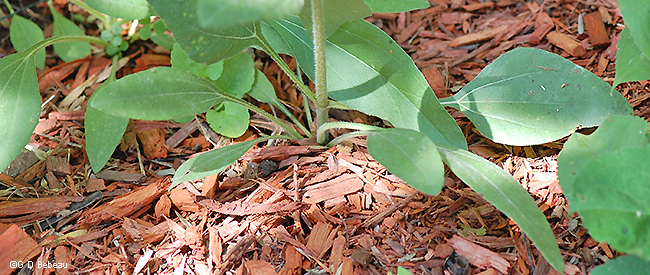
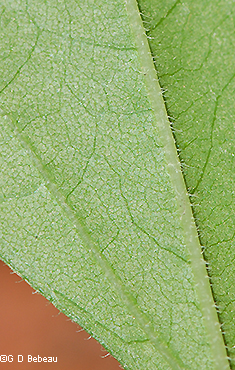
Below: The underside of the leaf has fine hair, longer on the ribs and edges. The plant stem is almost devoid of leaves. Plants getting lots of sun can have very reddish stems. The root is composed on long thin rhizomes.
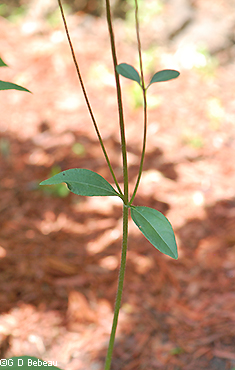

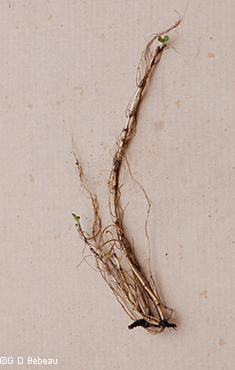
Below: The floral array has a sparse number of flower heads. Drawing from Britton, N.L., and A. Brown. 1913. An illustrated flora of the northern United States, Canada and the British Possessions. 3 vols. Charles Scribner's Sons, New York.
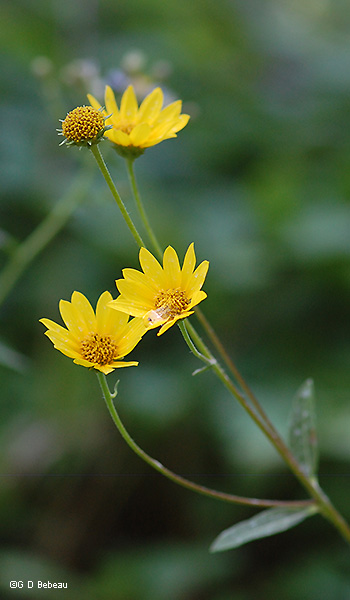
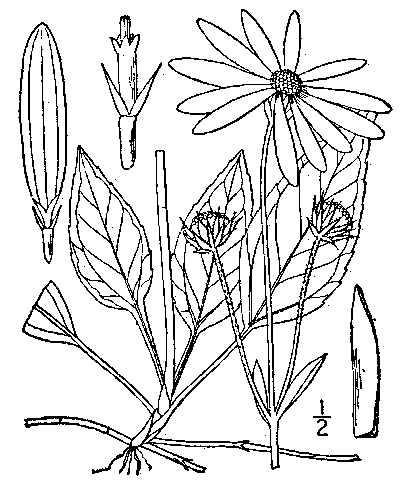
Western Sunflower is not indigenous to the Garden. Eloise Butler brought in the first plants in the summer of 1914 from the vicinity of Echo Lake at White Bear Lake, MN. She planted more in 1916, '18 and '20. Martha Crone did not list it on her 1951 Garden Census. It is considered native to Hennepin County where the Garden is located. In Minnesota, the subspecies encountered is subsp. occidentalis. The MN DNR reports that it is found in counties bordering Wisconsin from Pine south to Houston plus Ramsey and Hennepin in the metro. In North America it is generally located east of the Mississippi River (except for Texas and Kansas where it is found). In the East, it is absent in New York and New England. In the south it is absent in Louisiana, Mississippi and Alabama.
The species of Helianthus currently in the Garden are: H. giganteus, Giant Sunflower; H. hirsutus, Stiff-haired Sunflower; H. pauciflorus Stiff Sunflower; H. strumosus, Paleleaf Woodland Sunflower; H. tuberosus, Jerusalem Artichoke.
Varieties: The two recognized subspecies of H. occidentalis are: subsp. occidentalis, where the leaves have entire margins or nearly so with rough-to-the-touch surfaces, and subsp. plantagineus, where the leaves have serrate edges and are usually smooth to the touch. The latter subspecies is known only in Texas, Louisiana and Arkansas.
Return to -- Site Plan/Archive Index --or-- List of Common Plant Names -- or -- List of Scientific Names -- or --Home Page - - - Back to top.
References: Plant characteristics are generally from sources 1A, 32, W2, W3, W7 & W8 plus others as specifically applied. Distribution principally from W1, W2 and 28C. Planting history generally from 1, 4 & 4a. Other sources by specific reference. See Reference List for details.
 Identification booklet for most of the flowering forbs and small flowering shrubs of the Eloise Butler Wildflower Garden. Details Here.
©2015
Friends of the Wildflower Garden, Inc. Text and photos are by G D Bebeau unless otherwise credited. "www.friendsofeloisebutler.org"
100422