The Friends of the Wildflower Garden Inc.
Native North American Wildflowers
Common Name
Bradbury's Monarda (Eastern Beebalm)
Scientific Name
Monarda bradburiana
Plant Family
Mint (Lamiaceae)
Garden Location
Not in the Garden
Prime Season
Early Summer
Monardas all have flowers in dense heads with the stamens and style protruding from the corolla throat.
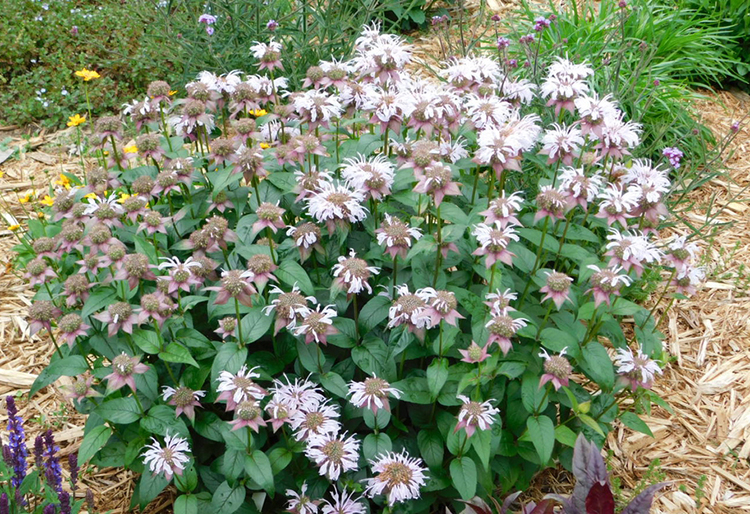
Stems: Bradbury's Monarda grows upwards to 2 feet high on typical 4-angled mint family reddish-green hollow stems that branch sparingly and are mostly hairless though they can have some gray hair at the stem angles.
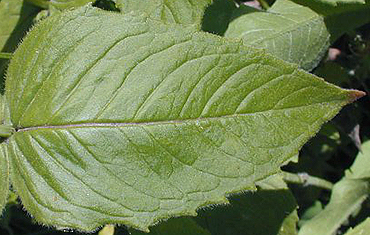
Leaves are opposite, the lower short-stalked, have a slightly grey appearance, are ovate to broadly lanceolate, up to 4 inches long and 2 inches wide. Upper leaves are not stalked. Teeth are less noticeable or absent on upper leaves. The green parts of the plant have a distinctive aroma of oregano when crushed.
The inflorescence is a solitary flower head, 1 to 3 inches wide, dense with numerous unstalked florets.
Flowers: The florets are tubular, pink to whitish, with corollas of 5 petals that form 2 lips - one lip formed from two fused petals forming an elongated tube that rises upward and surrounds and protects the 2 stamens and the style, which protrude beyond that upper lip. Three fused petals form one wider but shorter lip below which is purplish spotted. The calyx tube is shorter than the corolla, greenish then to deep pink when mature, with five pointed lobes. Flowers open from the center of the head first and progress to the outer edge. Under the flower head are green bracts, turning deep pink in flowering.
Seeds are a very small brownish-black dry nutlet, ovoid/cylindrical in shape with one end bluntly rounded, the other end more pointed. Each floret will usually produce 4 seeds. These will germinate upon planting without any special pre-treatment.
Habitat: This monarda likes full sun with moist to somewhat dry conditions. Best plant appearance will be with average soil and moderate moisture. Leaves are resistant to mildew. The plant grows from a rhizomatous root system that produces multiple stems in a cluster, but does not produce stolons, so the plant does not spread aggressively, but simply enlarges the clump. It may spread by occasional re-seeding. Long-tongued bees, hummingbirds and butterflies love the plant for the copious amounts of nectar produced.
Names: The genus name, Monarda, is an honorary for Spanish botanist Nicholas Monardes (1493-1588) who published a book in several editions on medicinal plants of the new world. The species bradburiana, is an honorary for John Bradbury, (1768-1823) english naturalist, member of the Linnean Society, who traveled to the interior of North America in 1809-1811, funded by the Liverpool Botanic Gardens to collect plants. Here he met Thomas Nuttall and took part in the Astorian Expedition. He visited Indian tribes, collected and sent seeds back to Liverpool, identified 40 new species. Like Nuttall, many of his plants were documented without his permission by Frederick Traugott Pursh. His account of the New Madrid Earthquake of 1811 is the only one by a person with naturalist training.
Comparison: Our most common wild monarda is M. fistulosa which has flower heads closely resembling Bradbury's, except that the plant is twice as tall. There is also a lesser seen more eastern native U.S. species - Purple Bergamot, Monarda media, which is not native to Minnesota and which differs by its darker reddish-purple color. Purple Bergamot tends to bloom earlier than Wild Bergamot and Bradbury's blooms earliest of the three. There are many ornamental cultivars available from the nursery trade of the monarda genus. These usually differ in height and flower flower color - the most common cultivar comes from Scarlet Beebalm, Monarda didyma, and is the deep red one called called 'Raspberry Wine'. All are shown below.
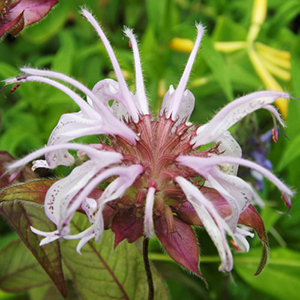
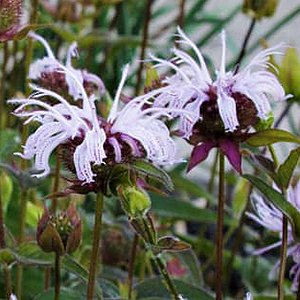
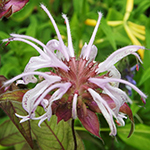
Above: The flower is pinkish white with a the 5-lobed calyx deep pink. The flower head resembles closely that of Monarda fistulosa. (Photo plantlady CC BY-SA 3.0) 2nd photo - the flowers are solitary atop a reddish-green stem with a set of bracts under the flower head, green initially, turning deep pink. (Photo K.Andre CC By 2.0)
Below: A large clump. The root system can produce multiple stems and enlarge by rhizome spreading. (Photo: K. Andre CC BY 2.0)
Below: The leaf is lanceolate in shape, very short stalked on the lower leaves, sessile on the upper. Fine surface hair with a toothed margin.
.
COMPARISONS: Other variations of Wild Bergamot are shown below. 1st photo is Purple Bergamot, Monarda media. 2nd photo is a nursery trade cultivar of Monarda didyma called 'Raspberry Wine.' 3rd photo is M. fistulosa which has flower heads closely resembling Bradbury's.


Below: The seeds are angled with one end pointed, the other more rounded.

Notes: Bradbury's Monarda has never been in the Wildflower Garden. It is native to the SE and South central U. S. ranging north to climate zone 5. With the climate zones moving northward, it will grow in southern Minnesota.
The University of Minnesota Herbarium lists three species of Monarda in Minnesota; the other two are M. punctata, Spotted Beebalm, and M. didyma, Scarlet Beebalm, although the DNR does not have a location for it currently and it is probably no longer in the state. In North America Wild Bergamot, in its various subspecies, is found throughout except for the Alaska, California, Florida and most of the very far north Canadian Provinces.
Medicinal Lore: Monarda plants besides having some of the taste of oregano on fresh growth, contain a substance called thymol, which is an antiseptic compound used in such products today (although manufactured) as mouthwash. This compound is why native Americans were able to use the plant as Densmore describes in her book on the Minnesota Chippewa (Ref. #5). The flowers and leaves were boiled to make a tea like brew in which children with skin burns and disruptions would bath in. Also, dried flowers and leaves, powdered and then moistened with a little water would be applied to a burn - said to be especially effective for scalds. Densmore refers to the older scientific name, M. mollis, which today, is considered to be within M. fistulosa L. subsp. fistulosa. The leaves of Bradbury's will also make tea.
Return to -- Site Plan/Archive Index --or-- List of Common Plant Names -- or -- List of Scientific Names -- or --Home Page - - - Back to top.
References: Plant characteristics are generally from sources 1A, 32, W2, W3, W7 & W8 plus others as specifically applied. Distribution principally from W1, W2 and 28C. Planting history generally from 1, 4 & 4a. Other sources by specific reference. See Reference List for details.
 Identification booklet for most of the flowering forbs and small flowering shrubs of the Eloise Butler Wildflower Garden. Details Here.
©2026
Friends of the Wildflower Garden, Inc. Text and photos are by G D Bebeau unless otherwise credited. "www.friendsofeloisebutler.org"
020626