Friends of the Wildflower Garden
Red brightens the Wildflower Garden
The color red is one of the first to appear in early spring, then retreats till sometime around early June. By August nature has presented us with her most brilliant color in many ways, not in clustered masses but as focal points of her composition.
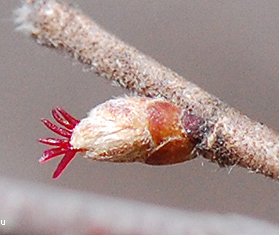
The first tinge of red appears in earliest spring in the form of a small bud before any leaves appear or other flowers bloom. The female flower of the hazelnut is so small and inconspicuous that only those looking for it are likely to notice. Only the deep red stigmas and styles emerge from the bud to catch pollen from nearby male flowers.
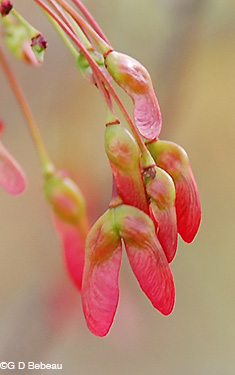
Next in the sequence of color are the flowers of the red maple. When pollinated, the paired samaras (also called keys) develop into another shade of red. Eloise Butler wrote in 1911: "The red swamp maple has glorified the lowlands with its flowers of brilliant hue, forming a pleasing contrast with the ash-gray stems. It is strange that this tree is not more often used for decorative planting. The flowers of the maple are succeeded by the scarlet wings of the pendulous fruit."

Henry Thoreau wrote in The Dispersion of Seeds: "About the middle of May, the red maples along the edges of swamps, their fruit being nearly ripe, are among the most beautiful objects in the landscape, especially if seen in a favorable light with respect to the sun. The keys are high colored, a sort of pink scarlet commonly, dangling at the end of peduncles three inches or more in length and only a little darker shade than themselves."
By this time of the season the fruits of the elderberry shrub have turned red and may be seen before the birds quickly devour them.

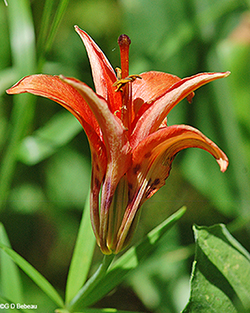
It would be neglectful not to mention the lily of early summer that has a red coloration - the native wood lily.
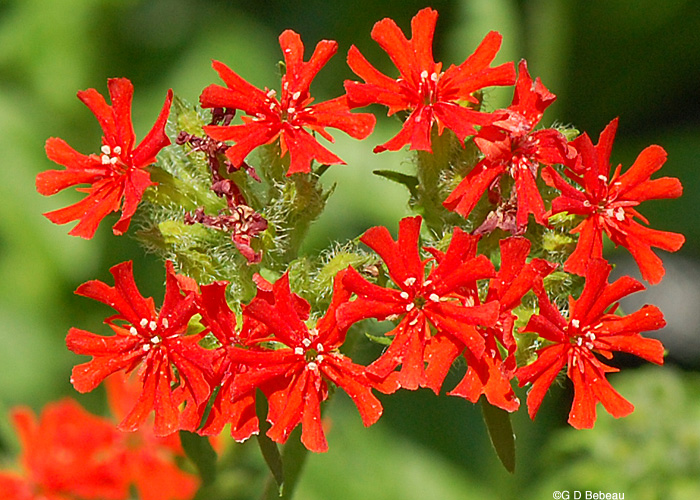
When the warm season flowers are ready to bloom we see next the brilliant shade of the Maltese Cross, also called scarlet lychnis. This is the first of two species we encounter of the Silene genus. Originally planted in the Wildflower Garden in 1915 it ended its tenure there in the upland sometime in the early 2000's.
Below: The brilliant flowers of the Maltese cross (Silene chalcedonica).
In the absence of the color of the Maltese cross we now see a replacement appearing slightly later in the season and named royal catchfly, a vivid tall prairie plant and our second Silene. Thomas Nuttall called it "one of the most splendid species in existence" in his The Genera of North American Plants and a Catalogue of the Species to the year 1817.
Last, but far from least, in the parade of red flowers is the cardinal flower, (Lobelia cardinalis) which was named for the color of the robes of the Roman Church Cardinals.
Eloise Butler Wrote of Cardinal Flower: "For the late-blooming flowers we must turn to the floodplains and meadows still glorious in the white, blue and gold of the moisture-loving asters, gentians, lobelia and sunflowers, tricked out here and there with the deep red of the Cardinal Flower - the purest red found in nature. The brilliant salvia now blooming in the cultivated gardens has a tinge of yellow in its redness, but that cannot be said of the red lobelia known as the cardinal flower." [Published 24 Sept. 1911, Minneapolis Sunday Tribune.]
Below: 1st photo Royal catchfly (Silene regia). 2nd photo Cardinal flower (Lobelia cardinalis).


Along with the flowers of summer we also have the red fruits of the raspberries of many types, the red drupes of goldenseal, the red berries of jack-in-the-pulpit, wild calla, winterberry, red baneberry and all the fruits of the serviceberries and hawthorns. Then late in the season appear the red drupes of the sumacs. All three of our sumac species develop red mature fruits - the staghorn, the smooth and the fragrant sumac, all covered with fuzzy hair. More brilliant from the lack of fuzzy hair is the fruit of the American cranberry bush.


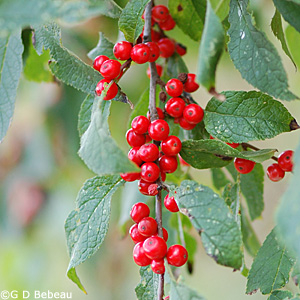


In autumn as the foliage dries on the eastern wahoo the reddish seed capsules in the shape of 4-cornered hats are displayed. Opening, they expose each seed coated with the red of the cardinal flower.
Below: The 4-sided fruit capsules of Eastern Wahoo (Euonymus atropurpureus) and the red seeds inside.


Lacking flowers to view in late fall we now have the leaves and none announce the coming end of summer as do those of the sumacs, the earliest to show their fall color. These are followed by a symphony of reddish leaves of which we provide a sampling in these photos.

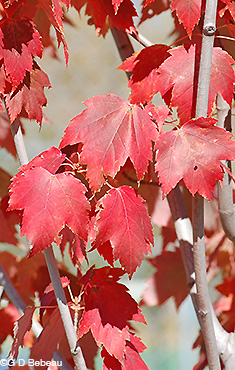


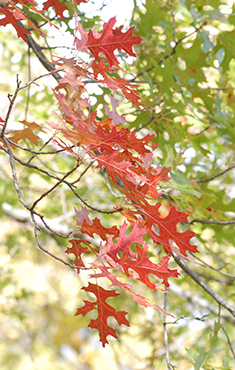
The reds of all these species do not overwhelm us, unlike the masses of yellow in the summer uplands. No, instead they provide an intense focal point to catch the eye, not aggressive and forever pleasing.❖
For information sheets on all the plants mentioned in this article consult our alphabetical plant lists:
Plants by common name
Plants by scientific name.
This article and photos by Gary Bebeau, a member of the Friends.