

A PUBLICATION OF FRIENDS OF THE WILDFLOWER GARDEN, INC.
Spring 2026
Volume 74 No 1
Print version
Downloadable version of printed copy
Quick Links to this Issue
Feature articles
Unknotting Oneself - Come back to the Garden
Eloise Butler Birds - a crossword
What's going on!
Unknotting Oneself
Come back to the Garden
by David Motzenbecker
It certainly has been difficult to be a Minnesotan lately. It seems every day we see news of yet another tragedy befalling our beloved State. Institutions we believed would remain inviolate are crumbling around us. The world, the United States, and especially Minnesota all appear tied in a Gordian Knot.
Legend tells of a wagon in the ancient city of Gordium (now located in modern Turkey) with an impossible knot tied to its yoke. An oracle stated that whoever could untie the knot would rule the entirety of Asia. In 333 BCE, Alexander the Great encountered the knot and instead of sorting through the layers, simply cut the knot in half with his sword.
New distractions emerge daily, pulling our attention in disparate directions, threatening to drive us mad as we attempt to keep up with the fusillade. Like the Gordian Knot, this is complexity as obstruction. What if we instead could see complexity as connection instead of conquest, as interdependence instead of frustration?
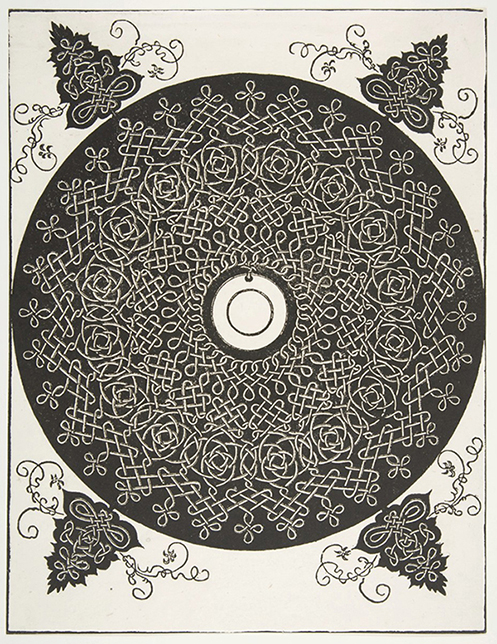
Other cultures, such as the Celts and Muslims have long crafted knots of intricate beauty focused on the ideals of continuity, harmony, and the infinite. Around 1485, Leonardo DaVinci began developing his own knot designs with no visible beginning or end, embodying the interconnectedness of nature. After visiting Italy, and possibly encountering DaVinci’s knots, Albrecht Dürer began crafting his own more precise versions in 1507 known as The Six Knots.
When I look at these knot diagrams, the designs hypnotize me, my eyes tracing their paths and finding not only immense beauty, but also metaphors for living systems. In nature, one can find myriad examples of knots serving deeper, connective purposes. Roots intertwine, mycelia extend, bringing life and resources to many interdependent species within the forest.
In the drawings or in nature, no one strand dominates. Knots are visual confirmations that life is enriched by crossing paths, not standing alone. We humans gain much more when we are connected in a network with others—human and more-than-human. A spirit is defined as an animating force, something that gives life. When we intentionally weave our spirits into those of the forest, when we breathe the oxygen that the trees offer up, when we spend deliberate time paying attention to the awe-inspiring nuances at the edge of the path, we are consciously crafting a deeper intellect and emotional bond with the natural world.
The forest does not move in straight lines. Neither do we. Our lives loop, cross, disappear, and return—like roots beneath our feet. The knot is not something we humans invented.
It is something we noticed.
What better place to cultivate this connection than within the gentle confines of the Eloise Butler Wildflower Garden. As its paths loop up and down, in their own circles and knots, they carry us into another world. This world of quiet birdsong and hushed breezes, waving prairies and interlaced canopies brings us calm. Take some time this season to be still and notice yourself as you wander within its embrace.
❖
Above: The knot in the background is the Sigil knot - Roots & Branches.
Below: Albrect Dürer: Knot with white disc, Meder #276, third of six knot woodcuts Dürer made ca 1506.
David Motzenbecker is an award-winning landscape architect and founder of Motz Studios who guides therapeutic forest bathing walks rooted in Shinrin Yoku and Stoic philosophy. Named one of ANFT’s top three certified walk leaders globally, he has led 2,800+ participants since 2018—helping high-performers slow down, reconnect, and return to what matters.
Thoreau in Minnesota
In search of health and crabapples
by Gary Bebeau
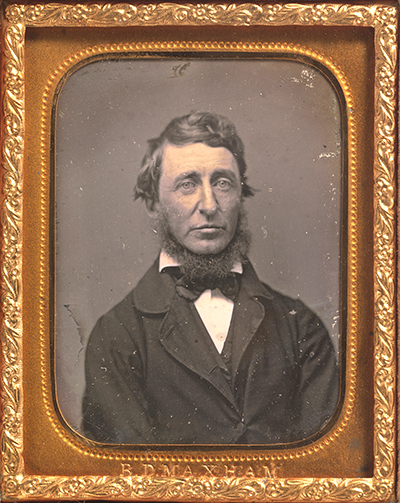
On May 23, 1861, Henry David Thoreau arrived at the Mississippi River near Dubuque Iowa and boarded the steamer Itasca for a trip up river to St. Paul. This journey from Concord was his longest and last away from his home base. He died a year later on May 6, 1862. He came west for a change of air to strengthen his health from the effects of tuberculosis. Traveling with him was young naturalist Horace Mann, Jr. [note 1]
Only one newspaper made note of his visit but that visit created some connections with the Friends of the Wildflower Garden 100 years later. Thoreau was not impressed with St. Paul. He and Mann remained in Minnesota for several weeks, staying for about 10 days at the boarding house of widow Elizabeth Hamilton near the south side of Lake Calhoun (now Bde Maka Ska) on a tract that is now 3810-3826 West Bde Maka Ska Parkway. He was very interested in the lakes, particularly Lake Harriet where he, Mann and Dr. Charles Anderson, a local geologist, spent much time examining the area and making field notes. Thoreau kept a journal that listed all the native plants he saw and identified. [note 2]
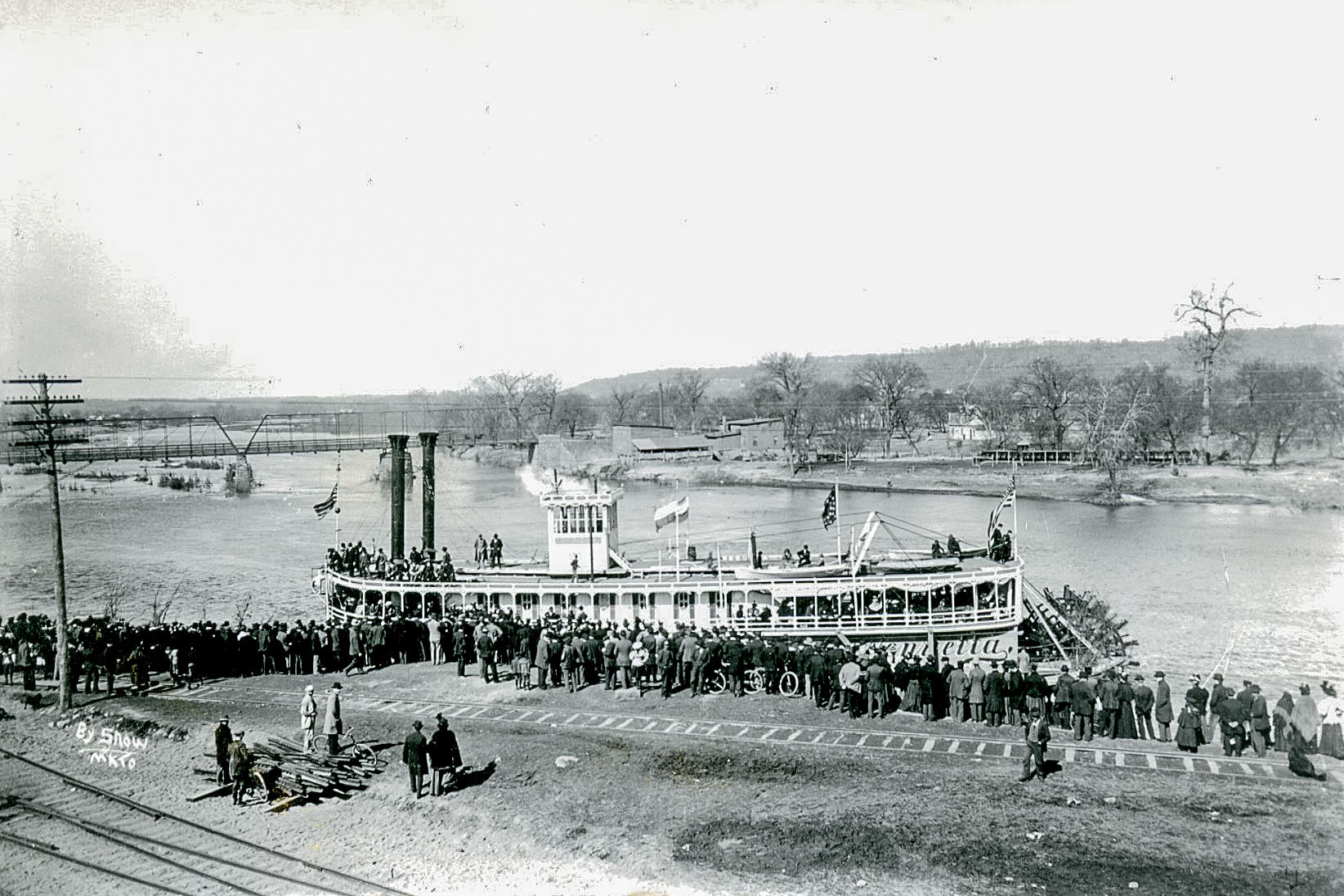
Following their lake stay, an opportunity came to take 6-day journey up the Minnesota River on the Franklin Steel, the same boat as Governor Alexander Ramsey’s entourage, who were traveling to the Lower Sioux Agency to make the annual annuity payment to the Mdewakanton Dakotas. Thoreau noted the Indians spoke eloquently but looked unhappy. The Dakota war broke out the next year. [note 3]
Thoreau wrote in a letter dated June 25, 1861:
“A regular council was held with the Indians, who had come in on their ponies; and speeches were made on both sides thro’ an interpreter, quite in the described mode; the Indians, as usual, having the advantage in point of truth and earnestness, and therefore of eloquence. The most prominent chief was named Little Crow. They were quite dissatisfied with the white man’s treatment of them and probably have reason to be so. This council was to be continued for 2 or 3 days – the payment to be made the 2nd day – and another payment to the other bands a little higher up the Yellow Medicine (a tributary of the Minnesota) a few days thereafter.”
Below: The steamboat Henrietta at Mankato. One of several boats like the Franklin Steel, that plied the Minnesota River. Photo - Brown County Historical Society. [Larger image]
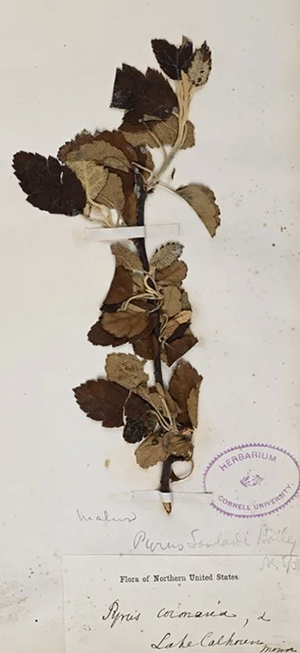
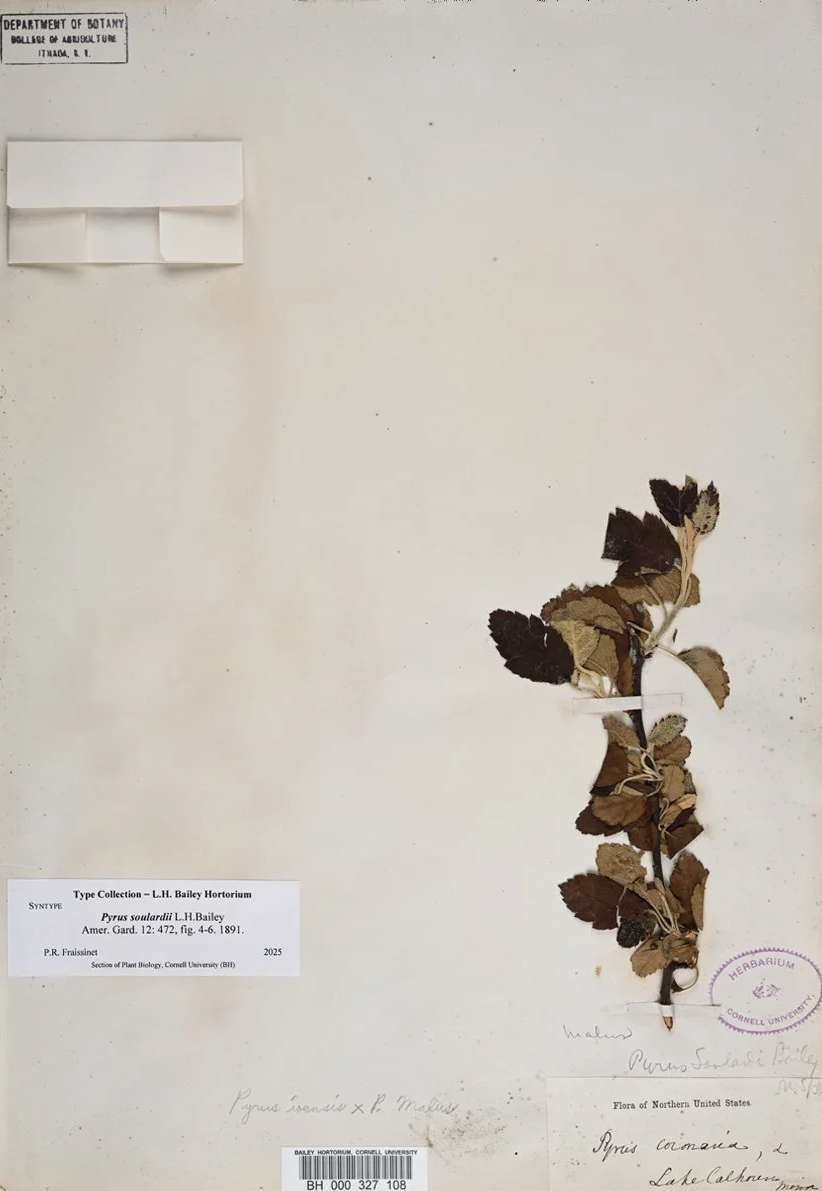
Of interest to us is Thoreau’s pursuit of crabapples, an obsession of his and he had not seen one close at hand until he reached Lake Calhoun where he “touched it and smelled it, and secured a lingering corymb of flowers for my herbarium.” The specimen he and Mann collected is known as Pyrus soulardi and resides in the herbarium of Cornell University. Thoreau’s journal contains these notes:
“She [Mrs. Hamilton] said the wild apple grew about her premises. Her husband 1st saw it on a ridge by the lake shore. They had dug up several & set them out, but all died. So I went & searched in that very unlikely place, but could find nothing like it. She then gave me more particular directions & I searched again faithfully & this time I brought home an Amelanchier as the nearest of kin, doubting if the apple had ever been seen there. But she knew both these plants. Her husband had first discovered it by the fruit. But she had not seen it in bloom here. Then called on Fitch & talked about it. [He] said it was found — the same they had in Vermont & directed me to a Mr. Grimes as one who had found it. He was gone to catch the horses to send his boy 6 miles for a doctor on ac[count] of the sick child. Evidently a [word?] & enquiring man. The boy showed me some of the trees he had set out this spring. But they had all died, having a long tap root & being taken up too late. But then I was convinced by the sight of the just expanding though withered flower bud to analyze. Finally stayed & went in search of it with the father in his pasture, where I found it first myself, quite a cluster of them.” [note 4]
Grimes was a pioneer horticulturalist and first president of the Minnesota State Horticultural Society. He established his Lake Calhoun Nursery near the lake. In addition to the Catalpa trees, the nursery was known for a 1,000-tree orchard and for growing the first Gingko tree in Minnesota. His granddaughter, Marian Grimes, wrote the following in The Fringed Gentian™ Vol. 31 No.1 March 1983:
“I had heard that Thoreau had visited my grandfather’s nursery in Edina. It was called the Calhoun Nursery, and I’ve been told it was the first nursery in Minnesota. My grandfather, Jonathan T. Grimes, came to Minnesota from Virginia because he disapproved of slavery. When my parents were married, Grandfather gave my father the eastern part of his farm, the block between 44th and 45th Streets and Beard and Chowen Avenues South.
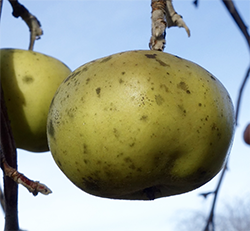
I like to think that the wild apple tree in our garden at 44th and Beard was the one Mr. Thoreau spotted. I picked many a gorgeous bouquet of blossoms from this tree in my child hood and gave them to neighbors. The apples, though! They were like round green olives, very hard, and didn’t even soften from freezing.
My mother, Jennie Alden, was a student of Miss Eloise Butler. The Jonathan T. Grimes home at 4200 West 44th Street in Edina is now listed on the National Register of Historic Places. It is considered to be the best example of Gothic architecture in a home in this area.” (note 5)
Dr. Marian Grimes (1903-1988), an early female physician in Minneapolis, was volunteer coordinator for the Friends of the Wildflower Garden from 1971 to 1980, a Garden shelter volunteer herself, a director of the Friends and active in the Minnesota Mycological Society. Minneapolis poet Betty Bridgman was editor of that issue of The Fringed Gentian™ in 1983 and at that date had lived on land that was once part of the Grimes farm for the past 43 years. Betty wrote over 650 poems; all have been published, including several dedicated to The Friends. [note 6] ❖
Notes
- 1. “Henry David Thoreau’s Final Journey: Minnesota,” Mayo Clinic Proceedings July 2018.
- 2. Walter Harding, e.d., “Thoreau’s Minnesota Journey”: p. 17‒18 and appendix. Thoreau Society.
- 3. “Thoreau’s Journey along the Minnesota River” - Scott County Historical Society 2019.
- 4. Thoreau’s article about this finding was published as “Wild Apples” in the Atlantic Monthly, November 1862, after his death.
- 5. Grimes established his orchard in 1866 after the civil war was over. When Thoreau visited his property it was not yet a nursery.
- 6. Betty Bridgman wrote two long works dedicated to the Friends can read on these links: Poem on the Dedication of the Martha Crone Shelter on May 13, 1970 and Ode to The Friends on their 30th Anniversary and on the 75th Anniversary of the Wildflower Garden.
Gary Bebeau is a Friends director and website coordinator.
Skunk Weed's Emergence
by Colin Bartol
Few sights in early spring are as quietly thrilling as the first emergence of skunk cabbage in the woodlands. Long before most wildflowers dare to bloom—sometimes while snow still lingers in shaded hollows—skunk cabbage pushes its way up through frozen ground, signaling that winter is loosening its grip. For visitors to the wetland of the Garden this remarkable plant is often the very first sign that a new growing season has begun.
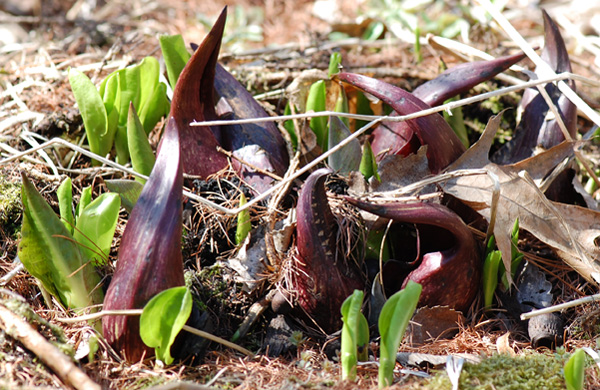
Symplocarpus foetidus, commonly known as eastern skunk cabbage, is native to wetlands and low woodlands across the eastern and midwestern United States, including Minnesota. It thrives in saturated soils along streams, seeps, and marshy depressions—exactly the kinds of habitats carefully protected within the Garden. Its preference for mucky ground means that finding it often requires a bit of adventurous footing if outside of the Garden in early spring, but the reward is well worth the effort.

What makes skunk cabbage so extraordinary is not just its timing, but its biology. The plant produces a hooded structure called a spathe, usually mottled in shades of deep maroon, purple, and green. This spathe wraps around a rounded flower cluster known as the spadix. While the spathe looks like a single bloom, the true flowers are the dozens of tiny florets tightly packed on the spadix inside.
Even more astonishing is the plant’s ability to generate heat, a process known as thermogenesis. Through rapid cellular respiration, skunk cabbage can raise the temperature inside its spathe well above the surrounding air, sometimes even melting the snow around it. This warmth not only protects delicate reproductive structures from freezing but also helps volatilize the plant’s signature odor.
That odor is often compared to rotting meat or a skunk’s spray, although it is not nearly as pungent as the corpse flower seen at the Como Park Conservatory. This smell plays a critical role in pollination. In early spring, typical pollinators such as bees are scarce. Instead, skunk cabbage relies on flies, carrion beetles, and other insects that are active in cold weather and attracted to decaying organic scents. Drawn by both the warmth and the smell, these insects crawl inside the spathe in search of food or shelter. As they move among the tightly packed florets on the spadix, they inadvertently transfer pollen from one plant to another.

The heat within the spathe may also provide a temporary refuge for insects on chilly days, encouraging them to linger longer and increasing the likelihood of successful pollination. This clever combination of warmth and scent represents a specialized adaptation to a season when few competitors are in bloom.
After pollination, the spathe withers away, and the plant’s large, bright green leaves begin to unfurl. By late spring, these dramatic leaves—often over a foot long—dominate the wetland floor, storing energy for the next year’s early emergence. By midsummer, they too fade back into the landscape, leaving little visible trace of the plant’s striking spring debut.
Skunk cabbage is more than a curiosity; it is a reminder of resilience and renewal. Each year, as it melts its way through snow and mud, it quietly announces that the cycles of nature are continuing as they always have. In its unusual beauty and ingenious pollination strategy, skunk cabbage invites us to look closely—and to welcome spring with wonder. ❖
Below: The fully grown leaves of skunk cabbage as they appear in mid-summer. Photo - G D Bebeau.

Colin Bartol is a Friends board member and editor of The Fringed Gentian™.
President's Greeting
Dear Friends,

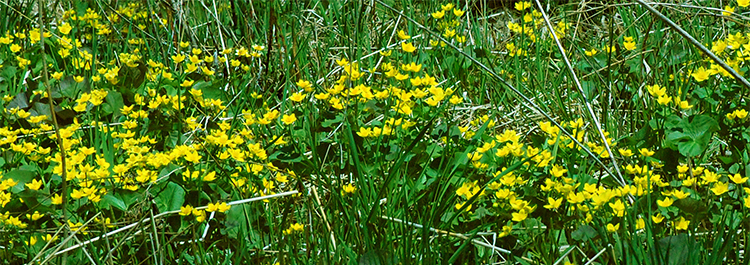
Always at this time of year, we look forward to the Garden opening. Eloise wrote in 1928: "On the afternoon of April 2, one or two buds of hepatica showed color and the venturesome flowers of snow trillium began to open. Shortly afterward, the next great pageant was staged – literally acres of lowland bespread with a cloth of gold – marsh marigold." Of the five Early Bloomers (the two above plus false rue anemone and skunk cabbage), the fifth is my favorite: bloodroot. Unlike the others, its beautiful leaves are visible through the summer.

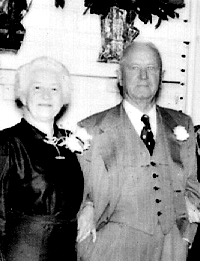
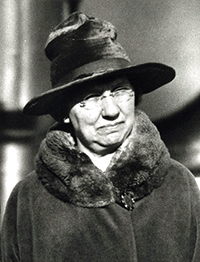
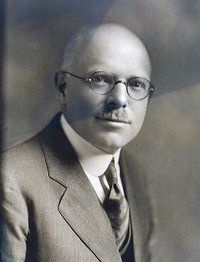
2026 is the 175th anniversary of the birth of Eloise Butler. She arrived in Minneapolis in 1874 from Indiana, where she had moved from her home in Maine with her parents. Immediately, she was hired at Central School and taught Latin and Greek to 7th and 8th graders. In her free time, she was botanizing along the Mississippi River – learning the plants. In 1878, she transferred to Central High School, teaching history and botany for 24 years, and then taught botany at South High School until she retired in 1911. Two of her high school students, Josephine Tilden and Frederic Butters, became botany professors at the University of Minnesota, and a third, Clinton Odell, founded the Friends of the Wildflower Garden in 1952.
In 1889, the Park Board (MPRB) purchased land between what is now Glenwood Avenue and I-394 and from Birch Lake to Xerxes Avenue. For years it was undisturbed, "an oasis of wild plants, birds, and animals, bogs, and wooded hills." Eloise’s Big Four – the four female botany teachers, one for each Minneapolis High School – would botanize there and bring students to experience nature. In 1907, the Big Four presented a petition to the MPRB: "a desire to preserve intact all the wild and natural features of the place; as a natural botanic garden". It was signed by all four high school principals, the University of Minnesota’s President Northrop, Josephine Tilden (Eloise’s former student who became the first woman science professor at the University), C.O. Rosendahl, Chair of the University’s Botany Department, and other science staff. On April 15, 1907, the request was granted for a three-acre garden.
Below: Three students of Eloise Butler.
The teachers began a census of the indigenous flora: sixteen species of trees, twenty-eight species of shrubs, ten species of ferns, and seventy-six species of wildflowers. When Eloise returned from her summer in Massachusetts, she counted fifty more species. Planting continued until November 5th with yellow lady slippers, pitcher plants, royal, maidenhair, and sensitive ferns, Dutchman’s breeches, wild ginger, skunk cabbage, and tall blazing stars, mostly dug up from local wild areas.
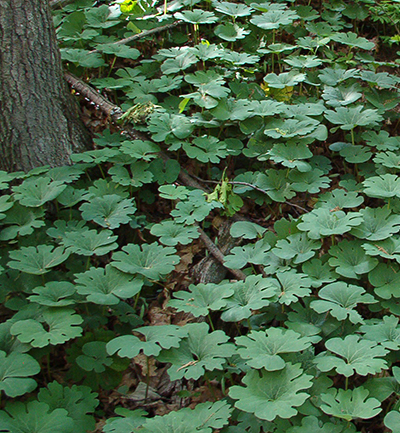
The Big Four wrote a full-page article on "The Importance of Botany…the only class about life/living: physiology, nutrition, and reproduction", which was published in the Minneapolis Journal in May 1909. While curating the Garden, Eloise was actively promoting the Garden – writing newspaper articles, speaking, and giving tours in the Garden.
By 1910 Eloise was no longer using her teacher’s summer vacation to go to the East Coast but was dedicating her time to the Natural Botanical Garden. In 1911, the Minneapolis Women’s Club petitioned the Park Board to hire a funded curator for the Garden and asked that Eloise Butler be appointed. Butler’s vision was to showcase all the flora of Minnesota. In 1929, the Park Board formally changed the name of the Garden to the Eloise Butler Wild Flower Garden, although she referred to it as the Native Plant Preserve or Wild Garden until she died.
Eloise enjoyed the poet William Wordsworth, who wrote about nature, both its wildness and its cultivation. In 1990 when the Friends funded a new Front Gate, they selected the Wordsworth quote “Let Nature Be Your Teacher” for the wooden top to honor Eloise Butler.
I am grateful for her vision and unfailing dedication to creating this wild botanic garden for all of us to enjoy 119 years later. We will be celebrating her all year!
Happy Spring, Jennifer Olson President of the Friends of the Wildflower Garden
Below: The arbor about the Wildflower Garden's front gate with the phrase from Wordsworth.

Archive of previous President's Letters.
The Garden is enjoyed by all!
from Garden Curator Susan Wilkins
With photos from The Friends archive of those who have enjoyed the Garden over the years.
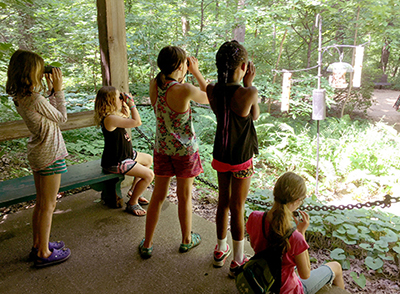
Through many rich seasons that have blossomed, borne fruit, and then senesced and decayed—becoming nourishment for the next year’s rebirth—I have had the opportunity to witness the enduring magic of this one and only garden. There is truly nothing that fully captures the beauty that unfolds here. It is profound to see how people are moved and opened to richer, more vibrant versions of themselves as they participate in the dance of nature here. The Garden brings out very good things in people, and it relies on very good people to carry it forward.
As we enter this new season, my heart is filled with gratitude for the many individuals who share their time, knowledge, wisdom, care, physical energy, and love for our wonderful Wild Botanic Garden—first envisioned nearly 120 years ago by Eloise Butler and a cohort of female botany teachers.
What is truly needed to honor this legacy is a volume crediting everyone who has loved and contributed to the Garden’s well-being over the years—from momentary acts to monumental ones. It would be an incredible story to read. In these few paragraphs, I simply wish to acknowledge the remarkable people who continue to support the Garden today, because its health and vitality are neither accidental nor assured. The Garden thrives because of people—staff, volunteers, the Friends of the Wildflower Garden, community members, and Park Board leadership—who care deeply about this place and the gifts it offers.
Visitors to the Wildflower Garden over many past years include school age youth (top photo), the young, the old, and the very old.
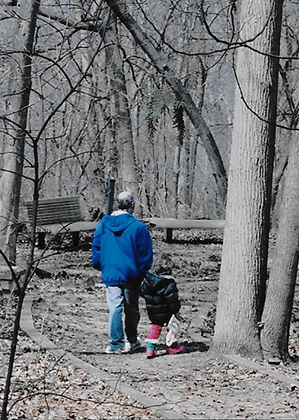
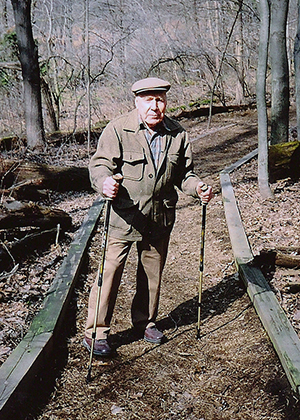
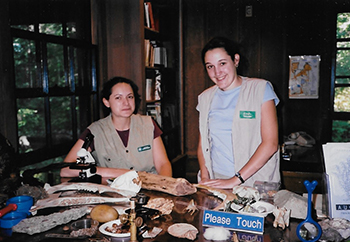
Over the years, many staff members have worked here, most often as seasonal employees, dedicating themselves to its care. Some stay for a season, others for several years, and all contribute meaningfully to the life of the Garden. They educate the public, support visitors and volunteers, and care for the landscape itself. From leading programs to planting the native flora visitors admire each day, these individuals carry out essential work that sustains the Garden. Their thoughtfulness and skill uphold the spirit and ethos of this special place.
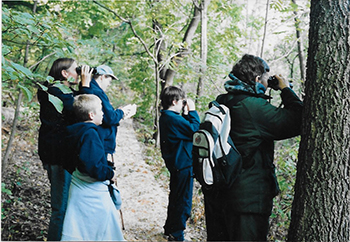
Equally vital are the Garden’s beloved volunteers. Docent Volunteers, Greater Eloise Stewards, and Legacy Volunteers bring an incredible level of continuity, connection and devotion to the Garden and Garden community. Through their work, they help cultivate awareness, stewardship, and joy among visitors in myriad ways. Each person who volunteers shares a part of themselves here, and together their efforts weave a fabric of care that people feel when they visit. Their presence helps bring the Garden to life and we are all the richer for it.
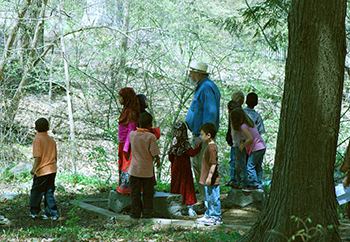
Since 1952, the nonprofit Friends of the Wildflower Garden has supported the Garden with integrity, intention, and steadfast commitment. Over the decades, the Friends have contributed in countless ways, helping strengthen the Garden’s resources and ensuring its continued vitality. Their long list of contributions reflects a deep and enduring bond to this beloved public garden. Truer friends could not be found.
Through the Friends, generous community members have also provided financial support that has made a meaningful difference in the Garden. Many features that visitors enjoy today were made possible through individual donations. More recently, thoughtful gifts have helped support naturalist staff salaries, allowing important educational programming to continue through the winter months. These contributions strengthen the Garden’s ability to serve visitors and deepen its role as a place of learning, reflection, and connection with the natural world.
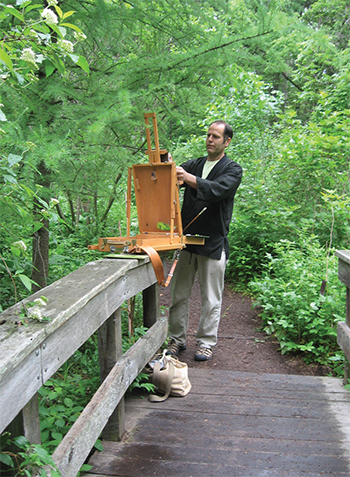
The Garden’s wider community—visitors, Florilegium artists, researchers, students, and program participants—also adds immeasurably to its spirit. Everyone who walks through the gates, studies the landscape, creates art inspired by it, or carries memories of it with them helps sustain the Garden’s living legacy.
The Minneapolis Park and Recreation Board has owned and operated the Garden since its founding in 1907. Through many decades of change, the Garden has remained a treasured asset. Today we find ourselves at a moment with growing recognition of the importance of this unique public botanic garden and all that it brings to the community. With thoughtful stewardship and support for this blossoming, its future holds tremendous promise.
The collective love and care for the Eloise Butler Wildflower Garden and Bird Sanctuary has grown season after season for nearly 120 years.
Thank you, Eloise, for giving us this place where we can grow wiser, more attentive, and more connected to the natural world. Your vision continues to flourish in this wild garden you began with such love and wonder.
See you on the trails! ❖ Susan
Susan Wilkins is Curator of the Eloise Butler Wildflower Garden. Her article and the photos of the Garden are presented courtesy of the Minneapolis Park & Recreation Board.
Read Susan's previous letters here.
Eloise Butler birds crossword puzzle
by Colin Bartol
Test your knowledge about the birds of Eloise Butler Wildflower Garden and Bird Sanctuary.
If you are viewing this on a phone, please download the print copy.
Download printable copy.
Answers at end of newsletter.
Interactive version below:
Highlight first box of a column or row and the proper clue is highlighted. You may type in your entry.
Eloise Butler observation:
A Large number of birds nest in the garden, and during the season most of the migrants reported from the state have been noted in the Garden. The tangled vine coverts, abundance of food and water, and protection from sportsmen have made the place a favorite of the birds. Song, vesper and swamp sparrows, catbird, bluebird, rose-breasted grosbeak, Baltimore oriole, brown thrasher, bobolink, marsh wren, scarlet tanager, indigo bunting hold matins and vespers in the leafy aisles along the brook, while those of brilliant plumage, together with goldfinch, Maryland yellow-throated hummingbird gleam like jewels in the foliage or as they dart through the air."
Eloise Butler, 1914 from Annals of the Wildlife Reserve
News and Notes
Greater Eloise Stewards Activities:
Since last fall The Greater Eloise Stewards have been uncovering parts of the past in the meadow north of the Wildflower Garden’s back fence and gate. This area was once open marsh and meadow with scattered trees on higher spots. It was kept moist by springs, seeps and water draining from Eloise Butler’s wildflower reserve.
In recent decades views of the area have been obscured by the growth of dense forests of buckthorn. The paths in the area which lead to the Garden’s back gate, once a tunnel of buckthorn are now being cleared so the native plants that once were abundant there can receive sunlight and regenerate or be re-introduced as necessary. Historically, this is the area where Eloise Butler created her Mallard Pool in 1932.
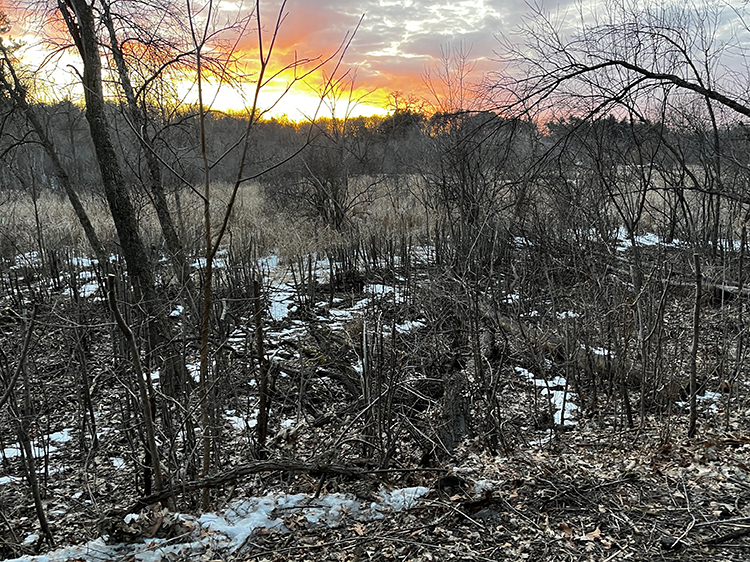
Below: Part of the extensive clearing of buckthorn in the north meadow done this past winter by the Greater Eloise Stewards. Photo Jim Proctor.
Notes For and About Our Donors and Volunteers
Annual Support information about:
1. Becoming an Annual Supporter of the Friends
2. Renewing your Annual Support
Can be found on our Website Donate & Support page.
Information on paying by check or by credit card is found there also.
For changes to your mailing address or email address, please use the annual support link on our contacts page or mail to: Friends of the Wild Flower Garden, Donor Support, P.O. Box 3793, Minneapolis, MN 55403-0793.
Other means of Support
Want to honor someone?
A gift in their honor can simply be a means of honoring a living person or some group
or
use this as an alternate type gift for a holiday, a birthday, an anniversary, etc. We will notify them of your gift and of how they will receive our newsletter and other communications for the year ahead. This will introduce them to the Friends and to the Garden. Use the mail-in form or the credit card link on our website 'Donate & Support' page.
Support Donor List
2025 - - - 2026 to date
Memorials Received
Memorials/In-honor-of Received
October 2025 to March 2026
IHO Jennifer Olson from Kari Gordon
IHO Pam Weiner from Deborah Boehm
IHO Susan Wilkins from Jennifer Scholl
All 2025 memorials - - - 2026 memorials to date
To make a donation go to our 'Donate & Support' page.
Board of directors positions
The Friends Board of Directors can use your talents! We are an all-volunteer board that meets several time per year and if you have an interest in the Wildflower Garden and in helping support it and our mission of educating the public about the Garden and the natural world get more details by sending an email to the "requests" link on our contacts page.
You can also support our program by buying a plant identification book.
 Do you have our Plant Identification Guide? The 3rd edition has 1,950 photos of the 787 flowering plants, trees and the ferns of the Eloise Butler Wildflower Garden including many that are of historic interest. Four hundred of these books have been sold, so why not get yours!
From a buyer in New Hampshire: What a terrific collection of photos. I’m sure this guide will be a great compliment to other guides I have. From Minnesota: I love the book and will cherish it for many years to come. Credit card order or use the mail order form, both on our website here.

Sign up for Twigs & Branches: A monthly email update from the Friends containing news from the Garden and relevant MPRB projects, as well as access to website content featuring short articles from our Board and membership. These articles are written to highlight connections of the plants, history and lore of the Eloise Butler Wildflower Garden with different time frames or outside events.
If you already are signed up for our emails, you should be getting these. If you are not here's the link to the sign-up form. The form also allows you to sign up for our Fringed Gentian™ announcements and for the Friends Invasive Plant Action Group's emails.
The Fringed Gentian™
is published for supporters of the Friends and the Eloise Butler Wildflower Garden.
The Fringed Gentian™ Staff:
Colin Bartol, editor.
Betsy Kerr, copy editor.
Bob Ambler, staff photographer.
Karen Kopacz, fringed gentian illustration.
The Friends
Officers/Directors
Print version
Downloadable version of printed copy
Return to OR Learn more:
Spring note
The springtime's pallid landscape
Will glow like bright bouquet,
Though drifted deep in parian
The village lies to-day.
The lilacs, bending many a year,
With purple load will hang;
The bees will not forget the time
Their old forefathers sang.
[Emily Dickinson]
Below: Shadblow serviceberry (Amelanchier canadensis) in bloom in May. One of eight serviceberries that have grown in the Eloise Butler Wildflower Garden and Bird Sanctuary. Photo G D Bebeau.

Crossword answers
Down
1. Cuckoo
2. Shrike
3. Wood
4. Coopers
6. Towhee
9. Rock
10. Ruby
11. Killdeer
12. Ovenbird
13. Creeper
15. Heron
Across
5. Scarlet
7. Indigo
8. Warbler
14. Vireo
16. Turkey
17. Merganser
18. Pileated
19. Barred
*Photo note: Photos with a “CC” credit are used for educational purposes under Creative Commons license. Learn about this at https://creativecommons.org/share-your-work/cclicenses/
©2026 Friends of the Wildflower Garden, Inc. www.friendsofeloisebutler.org.
Non-commercial reproduction of this material is allowed without prior permission but only with the acknowledgment to Friends of the Wildflower Garden, Inc., the author and the photographer.