These short articles are written to highlight the plants, history and lore of the Eloise Butler Wildflower Garden to past and contemporary events and may include personal commentary of the writer, not necessarily related to the Wildflower Garden. A web of present and past events.
July 2026
Articles
Featuring the Eloise Butler Birthday Events
Eloise Butler's 175th Birthday Celebration
Eloise Butler Beer Release Event
Minnesota's Native Milkweeds (page from website)
The poppy mallow - revisiting a genus that Eloise planted 100 years.
Wash Your Greens (and peaches and more)
Our Plant Identification Book - still available.
Eloise Butler's 175th Birthday Celebration at the Garden!
Join Garden staff and the Friends of the Wildflower Garden from 12-4pm on Sunday, August 2 to celebrate Eloise Butler’s 175th Birthday! Yes, it's one day early but close enough. See the next event below for what happens on her real birthday date.
Here is what to expect:
- Two special Botanical Birthday Tours are scheduled at 1pm and 3pm (45 minutes each) with Garden staff.
- Visit a station at the Shelter where you can write and share a note of gratitude to Eloise Butler or a love letter to the Garden or both!
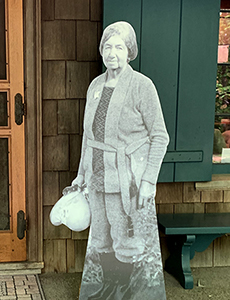
- Take your photo with a life-sized portrait of Eloise herself while nibbling on cookies and sipping lemonade in the Garden.
- Talk with staff and the Friends to learn more about all of the amazing Garden events and happenings taking place this summer and fall!
A great day to remember the woman and her fellow teachers who started this garden 119 years ago.
Eloise Butler Beer Release Event!
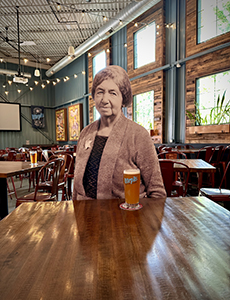
Join a gathering of Friends' Celebrating Eloise's 175th Birthday at Utepils with their Launch of the new "Eloise" Beer and Mocktail.
When: Monday August 3rd from 4:00-8:00 PM
Where: Utepils Brewery, 225 Thomas Ave North (just minutes from the Garden)
Why: On Eloise Butler’s birthday, Utepils launches their new beer "Eloise" and kicks off their round-up fundraising for the Friend’s Front Entrance Project! Here is a list of what is going on:
- Friends' table with Garden info, Bell Florilegium and Garden Fundraising for the Front Entrance!!
- Photo op with Eloise Standup!
- During the month of August, round up beverage purchases to the nearest dollar and Utepils will donate the change to the Friends' Front Entrance Project!
All are welcome! Bring family, friends, and neighbors to celebrate!
Eloise Butler Council Ring
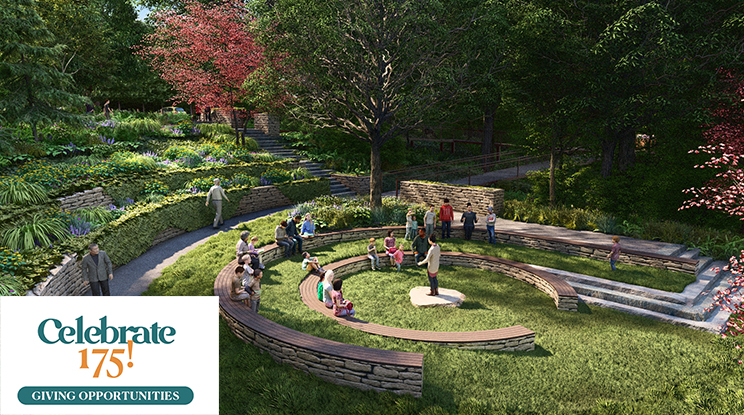
The Minneapolis Park & Recreation Board has designed the first phase of a renovation of the Garden's entrance. A centerpiece of the project is a new Council Ring—a welcoming gathering space where visitors can connect with one another, participate in educational programs, and begin their Garden experience.
In honor of Eloise Butler’s 175th birthday, the Friends of the Wildflower Garden are raising $175,000 by November 2026 to help fund the new Council Ring. Thanks to many generous supporters, we’ve already secured $100,000—help us raise the remaining $75,000 and give a lasting birthday gift that will welcome and inspire Garden visitors for generations to come.

For more than a century, visitors have found beauty, inspiration, learning, and connection in the Eloise Butler Wildflower Garden and Bird Sanctuary. Now, as we honor Eloise's legacy, we have a unique opportunity to invest in the Garden's future. As we celebrate Eloise Butler's 175th birthday, we invite you to be part of the Garden's next chapter. Together, we can ensure that this beloved sanctuary continues to inspire wonder, foster biodiversity, and connect people with nature for generations to come.
To make a gift or learn more, visit our council ring page or scan the QR code.
Minnesota's Native Milkweeds
This new article with photos is published as a separate webpage. Click here for the page.
The poppy mallow - revisiting a genus that Eloise planted 100 years.
Lets look at one of the genus - Callirhoe bushii, Bush’s Poppy Mallow. What an outstanding color is this flower! A 2-½ inch wide drop of magenta that will catch the eye in any garden, particularly when contrasted with a green backdrop.
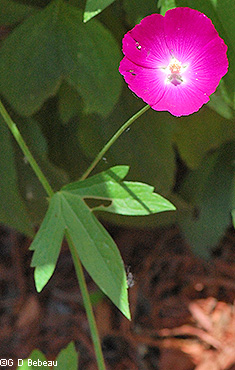
This is not a Minnesota native but has its native range in the central Mississippi Valley, once as far north as Iowa. But it does grow very nicely here in the southern half of Minnesota with a long flowering period. They say it does not like clay type soils, but my plants don’t seem to care.
This is one of 9 poppy mallows found throughout the central and eastern U.S. from the Rocky Mountains eastward except the NE area from New York to Maine. Only one of those nine is found in Minnesota down in Wabasha County.
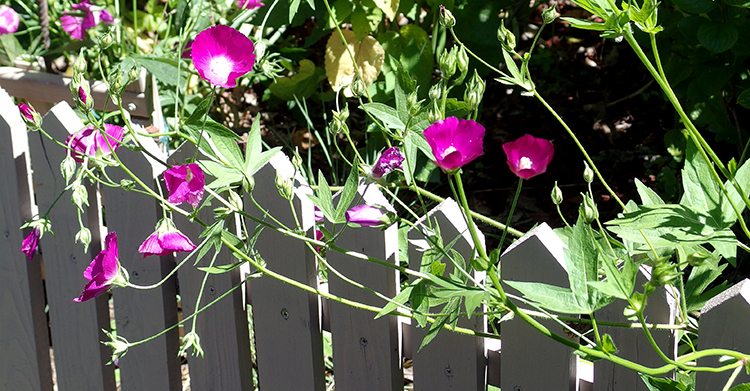
Anything not to like about it? Well, there are pros and cons. While it grows only 12 to 18 inches high on stems that are partially erect and arching, the stems continue to grow thus taking up the rambling habit, resting on other plants or on any supporting structure. While continuing to grow they keep producing flower buds thus prolonging the flowering period to about 6 weeks beginning around July 1 which is a definite pro. Another pro or con depending on what you think a plant should do, is that it re-seeds itself nicely thus expanding its territory. That’s controllable if you don’t like it. Each plant has a sturdy taproot resembling a white carrot which, once established, does not care to be transplanted.
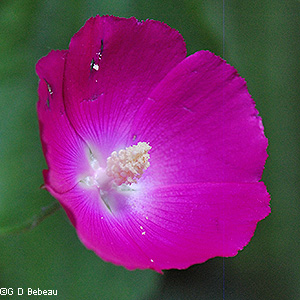
With all that said, you may like it.
One hundred years ago Eloise Butler planted two species of poppy mallow in her wild garden. C. involucrata, the Purple Poppy-mallow and C. papaver, the Woodland Poppy-mallow. The differences in most of the Callirhoe species are in the leaves and the bracts on the flower stem. The flower and colors are all very similar. Several of the Callirhoe species are available from Minnesota native plant sources.
The name and species, bushii, is an honorary for American botanist Benjamin Franklin Bush (1858-1937), who discovered the plant, but left the famous botanist Asa Gray to publish the description and apply the honorary name. Then Merritt Fernald finalized it.
Below: Bush's poppy mallow using a short fence for support. Note how multiple flower buds arise from the stem nodes along the plant stems.
Wash Your Greens (and peaches and more)
The recent outbreak of contaminated lettuce brings to mind the need to wash produce before using as a precaution against other contaminants that may be residuals from the process of growing the produce.
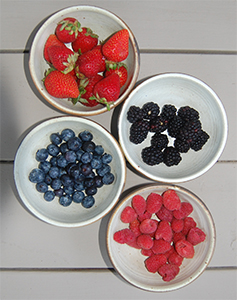
Spinach topped the 2026 annual list of the “dirty dozen” published by the non-profit Environmental Working Group (EWG).
The “list” is the tally of fruits and vegetables with the highest amount of pesticide/fungicide residual by weight. The other eleven are kale (including collard and mustard greens), strawberries, grapes, nectarines, peaches, cherries, apples, blackberries, pears, potatoes and blueberries. NOTE: This produce is already rated as safe for consumption by the EPA, so the produce is under the legal limit for these chemicals but the fruits and vegetables are not necessarily free of residuals. More than 30% of the samples tested contained forever chemicals such as PFAS.
The EWG recommendation is to wash all fruit and vegetables, including the organics, but not using any soaps because they are not food safe. The basic wash recommended is 20 seconds under running water or soaking for 15-20 minutes in water. More removal is attained by adding a teaspoon of baking soda to a cup of water and soaking for 5-10 minutes, then rinse it off.
Nothing completely removes these residues but the less left, the better your health.
The most pesticide free were pineapples, sweet corn (fresh or frozen), avocados, papaya, onion, sweet peas (frozen), asparagus, cabbage, cauliflower, watermelon, mangoes and bananas.
The EWG website https://www.ewg.org/
Our Plant Identification Book - still available.
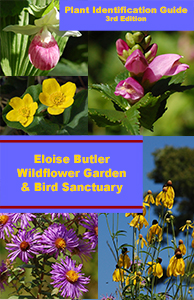
It has been some time since we mentioned our book of photos - that is the Plant Identification Guide to the Wildflower Garden. Gardeners and plant lovers in 34 states have bought the book. Recently a person in New Hampshire purchased her second copy saying “I need a second copy when I in my car as well as the one at home. I find it very useful.”
Others have written:
MN: "I love the book and will cherish it for many years to come."
NH: "What a terrific collection of photos. I’m sure this guide will be a great compliment to other guides I have."
OH: "Really appreciate the attention given to leaves, phyllaries and fruiting bodies."
We don’t put these testimonials on the cover so you can still buy your uncluttered copy without advertising for $22.95 at this link.
Refresher: This edition is a spiral bound booklet, 8-1/2 x 5-1/2 inches, 264 pages, 1,949 thumbnail photos of 678 species of wildflowers and small shrubs, 35 species of ferns, and 74 species of trees of the Eloise Butler Wildflower Garden - plants contemporary and historical to the Garden. All plants are native or introduced to Minnesota and most can be found outside the Garden in Minnesota and in the northern states in the eastern half of the U.S. as the testimonials indicate and I’m sure the buyers in Florida and Texas found it useful also.
Historical Photo
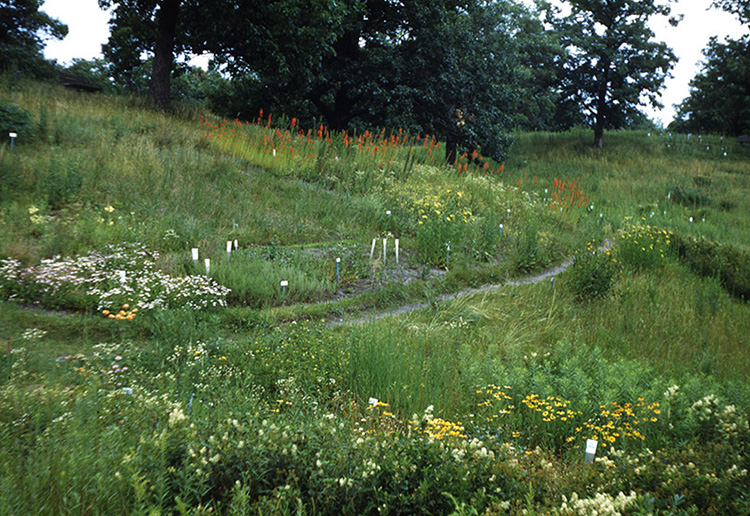
The upland garden center hillside in summer after 6 years of development. Photo ©Friends of the Wildflower Garden from a Kodachrome by Martha Crone, July 30, 1950.