The Friends of the Wildflower Garden
Minnesota Native Milkweeds
The explosion of interest in the conservation of pollinator communities has furthered interest in these plants which number 77 species in North America and 13 that are native to Minnesota. The Asclepias genus (the milkweeds) is the most studied genus of the Apocynaceae (dogbane) family for their reproductive and defensive strategies. The pollination method is quite unique.
Nine of the 13 Minnesota species have been present in the Eloise Butler Wildflower Garden (EBWG) over the years. All 13 are illustrated here. Two are so rare that they are found in the wild in only one Minnesota County, another is so common it is found in 86 of our 87 counties.

Basic descriptive terms: Milkweeds are perennials with alternate or opposite leaves ranging from broadly oval to very narrow and long. All species die back during the season, all produce upright seed follicles on straight stems or downward curving stems that then turn upward, with seeds that have long feathery wings attached for air transport. Most prefer full sun. The flowers are 5 parted with corollas in a variety of colors. Milkweed flowers have 5 erect hood-like nectaries with the petal parts bent downward.The hoods have small horns. The hood may have color shades different from the petal parts. Some species spread by rhizomatous roots, others by seed. A few of those with rhizomatous roots are notes as very aggressive and care should be take as to where they are planted.


Pollination: The unique flower structure of milkweed hoods and horns requires a strong insect, such as a bumblebee, to remove pollen and transfer it to another plant. The mechanism by which the plant releases pollen and accepts pollen from another plant is detailed at the end of this article.
Defensive measures and toxicity: The stem of the plants contain a latex like liquid, milky or sometimes clear, that contains compounds that are cardiac glycosides, asclepiadin and asclepione. Several insects, such as the monarch butterfly have sequestered these compounds in themselves to create their own defensive compounds. Eloise Butler wrote in 1911:
Crawling insects are likely to be covered and impaled by this sticky fluid, which exudes from wounds made by their sharp claws, as they scale the stems of the plants, and thus prevents them from rifling the nectar provided by the flowers for the pollen-distributing, hairy-bodied flying insects.
Descriptive notes: These notes below are more general with more descriptive detail available on our plant pages for species in EBWG or on authoritative sites such as Flora of North America.

Swamp Milkweed or Rosy milkweed, Asclepias incarnata subsp. incarnata. Minnesota’s most common milkweed, with flesh-pink to rosy-purple flower corollas, forming erect semi-round umbels at the tip of flowering branches at the top of the plant. The erect pinkish umbels distinguish this species from others of similar color where the umbels are nodding. Leaves are opposite and lance-like. Seed follicles upright on straight stalks. It prefers moist sunny areas. The roots are rhizomatous, but not aggressively spreading.
Swamp milkweed is found in 86 of Minnesota's 87 counties. It is indigenous to Eloise Butler Wildflower Garden. See the information sheet.


Common milkweed, Asclepias syriaca. Minnesota’s 2nd most common milkweed, has lighter colored rosy-pink umbels that are attached to the upper and mid-stem leaf axils and nod downward. Leaves are opposite and ovate. Seed follicles upright on stalks the re-curve upward. This species also has rhizomatous roots and while it is extremely popular as a host for the monarch butterfly, be careful planting it as the roots are most aggressive and in good soil will spread extensively, to the point that the plants seem to move across the garden from season to season and form large colonies. It will grow in partial to full sun in a wide variety of soil and moisture conditions. There have been many folk and medicinal uses of this plant.
Common milkweed is found in 78 of our 87 counties. It is indigenous to the Eloise Butler Wildflower Garden. Read the notes in our information sheet.


Whorled Milkweed, Asclepias verticillata. A shorter milkweed, growing to 24 inches high, leaves linear, narrow, ascending and in whorls. Flowers white in long stalked clusters from the upper leaf nodes. Seed follicles upright on straight stalks Will grow in poor soils. Rhizomatous. The whorled leaves and the white flowers distinguish it from other milkweeds.
Whorled milkweed is found in 59 of our 87 counties. Eloise Butler introduced it to the Wildflower Garden in 1910. Information Sheet.
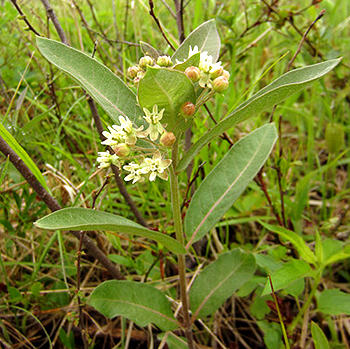
Oval-leaved milkweed, Asclepias ovalifolia. Leaves opposite and broadly ovate, flowers cream to yellowish in very short stalked clusters from the upper leaf axils. Seed follicles upright on up-curved stalks. Downy hair on leaves and stem. Short plant, stem unbranched. The MN counties with North Dakota, Manitoba and Saskatchewan form the core population in North America. Elsewhere there are concerns.
Oval-leaved milkweed is found in 55 of our 87 counties. Eloise Butler brought it to the Wildflower Garden in 1915.
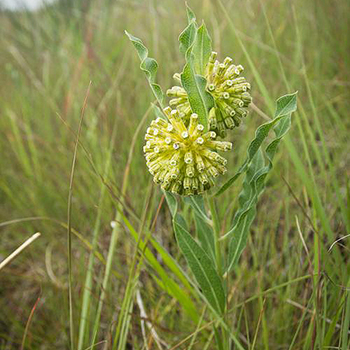
Green milkweed, Asclepias viridiflora. Leaves opposite, variable, linear to almost oval, flowers green to yellowish green, in dense clusters from the upper leaf axils. Stems 10 to 40+ inches high. Seed follicles upright on up-curved stalks.
Green milkweed is found in 47 of our 87 counties and was introduced by Martha Crone to the Wildflower Garden in 1955.
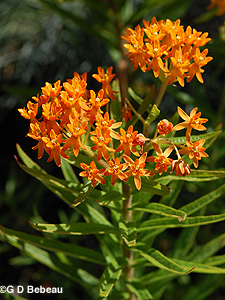
Butterflyweed, Asclepias tuberosa subsp. interior. Leaves alternate, long and narrow, no stalks. Stems short - 1 to 2 feet high. Flowers yellowish to deep orange in upright clusters on branches from the top of a hairy stem. Clear juice. Seed follicles upright on up-curved stalks. Grows from a taproot. Reseeds and taproot clusters expand. There have been many folk and medicinal uses of this plant. The alternate leaves and the orangish flowers distinguish this species.
Butterflyweed is found in 43 of our 87 counties. It was introduced to the Wildflower Garden in 1908 by Eloise Butler. Read the notes in our information sheet.


Poke milkweed, Asclepias exaltata. leaves broadly elliptical, opposite, long stalked. Stem 2-6 feet high. Flowers light green to pale purple with white hoods in several drooping open clusters from top of the stem, each flower long stalked. Seed follicles upright on up-curved stalks. Prefers shady woodland locations.
Poke milkweed is found in 35 of our 87 counties and is indigenous to the Eloise Butler Wildflower Garden. Read notes in our information sheet.
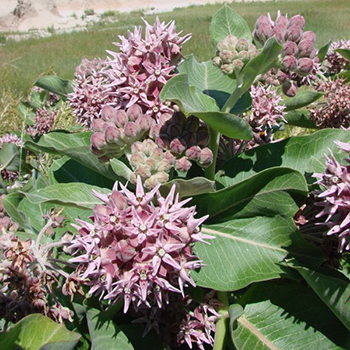
Showy milkweed, Asclepias speciosa. Leaves opposite, broad, lance-like to ovate. Flowers pink to dark pink tinged in upright long stalked clusters from the upper leaf axils. Corona (central structure of the flower) very wide with hoods pointed outward - compare to common milkweed illustration at top of page. Seed follicles upright on up-curved stalks. This is the western U.S. version of common milkweed and in Minnesota where the two populations come together they hybridize making species identification difficult. Like A. syriaca, it is aggressively rhizomatous.
Showy milkweed is found in 28 our 87 counties. There is no record of it ever being in the Eloise Butler Wildflower Garden.
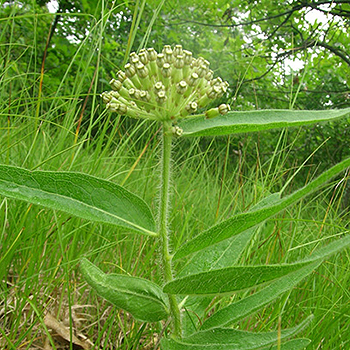
Wooly milkweed or small-green milkweed, Asclepias lanuginosa. Leaves opposite or alternate, finely hairy, lanceolate, stems hairy. Flowers greenish cream, sometime with purple tinges, in an upright terminal cluster, usually only 1, each flower long-stalked. Seed follicles upright on up-curved stalks. Short plant, rarely over 10 inches high. Stems hairy. Flowers early.
Wooly Milkweed is found in 24 of our 87 counties. The date of introduction to the Eloise Butler Garden is uncertain, but it was listed on Martha Crone's 1951 census.
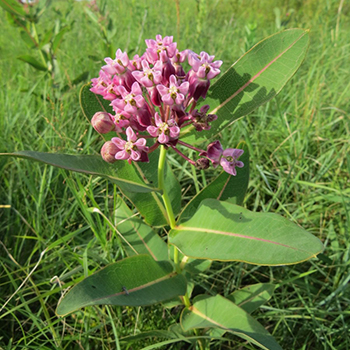
Sullivant’s milkweed, Asclepias sullivantii. Leaves opposite, clasping the stem, egg shaped to oblong. Stem short, unbranched. Flowers dark pink with pale bases in clusters from the very upper leaf axils. Seed follicles upright on up-curved stalks. Stem and leaves without hair. Rhizomatous.
Sullivant's milkweed is found in 23 of our 87 counties. It is listed on the Minnesota threatened plant list. The counties are in the western and southwestern section of the state. It was introduced to the Eloise Butler Wildflower Garden in 1929.
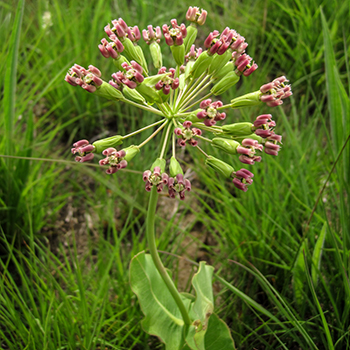
Clasping milkweed or blunt-leaved or sand milkweed, Asclepias amplexicaulis. Leaves opposite, ovate to oblong, clasping stem. Flowers green with red, purple or bronze tinged lobes in a terminal long-stalked cluster. Western U.S. plants have a more creamy colored flower. Seed follicles upright on up-curved stalks.
We now come to the rarer milkweeds. Clasping milkweed is found in only 5 of our 87 counties, all in the SE of the state. It is listed on the Minnesota threatened plant list. Eloise Butler however, introduced it to the Wildflower Garden in 1930.
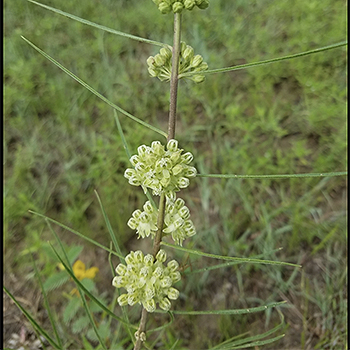
Narrow-leaved milkweed, Asclepias stenophylla. Leaves alternate or opposite, linear, very narrow and long, with short stalk or none. Flowers green to creamy green in upper stem axil clusters held close to the stem. Seed follicles upright on straight stalks.
The first of the two rare milkweeds found in only 1 Minnesota county - Houston. It is listed on the Minnesota endangered plant list. There is no record of it being in the Eloise Butler Wildflower Garden.
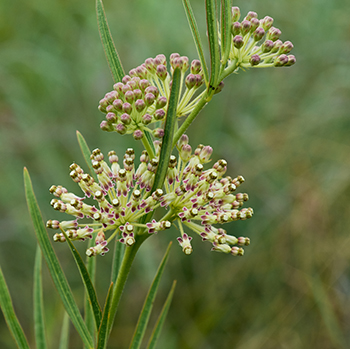
Prairie milkweed or tall-green milkweed, Asclepias hirtella. Leaves alternate or opposite, upward pointing, much longer than wide on tall stems. Flowers green to creamy green with red-violet tips in numerous upright usually un-stalked clusters in the leaf axils of the upper third of the stem. Each flower long stalked. Seed follicles upright on up-curved stalks. Short stiff hairs on leaves and stem.
The second of the two rare milkweeds found in only 1 Minnesota county - Mower, but the population is apparently large enough that it is listed on the threatened plant list, not the endangered list. There is no record of it being in the Eloise Butler Wildflower Garden.
The pollination system of Milkweeds works like this: The pollen of the milkweed is not in the form of free grains attached to an anther, but is contained in a waxy sac called a "pollinium" [plural - pollinia] with each sac having about a few hundred grains. Each Milkweed flower has two ovaries connected to the five flower parts, each part has a very short pistil with an enlarged stigma which has the form of a deep slit. Pollina sacs are in pairs with one sac located on each side of the stigma and each of the pair of sacs is connected by a 'translator arm' to a structure called a 'corpusculum' which sits atop the stigma slit. There is a groove in the corpusculum and the foot of an insect, such as a bee or butterfly, gets caught in the groove and when the foot is pulled out, the pair of sacs and the associated structure comes along with the foot and thus are then carried from flower to flower by the insects resulting in pollination. Any insect large enough and strong enough to remove the sac can fertilize another plant.
The method of fertilization is also interesting. Once a corpusculum has been pulled out, after a few minutes, the translator arms rotate the pulled out sacs 90 degrees. After the rotation when the insect reaches another flower, the sac is now in position to fit into the bottom of the slit in the stigma. As the insect moves its foot the sac is pulled upward in the slit until it hits the still existing corpusculum of that flower. At that point the translator arm snaps off and the pollen sac is in position to fertilize the flower. When the corpusculum of that flower is still present it is possible for the insects foot to catch it and thus remove another pair of pollen sacs for another go at the next flower. When the corpusculum of a flower has already been removed the chances of the translator arm breaking off are reduced and the pollina sac may not be broken off and is carried away by the insect to another plant.
Below: These diagrams illustrate the pollination sequence described in the text. Diagram ©Douglass H. Morse, Brown University
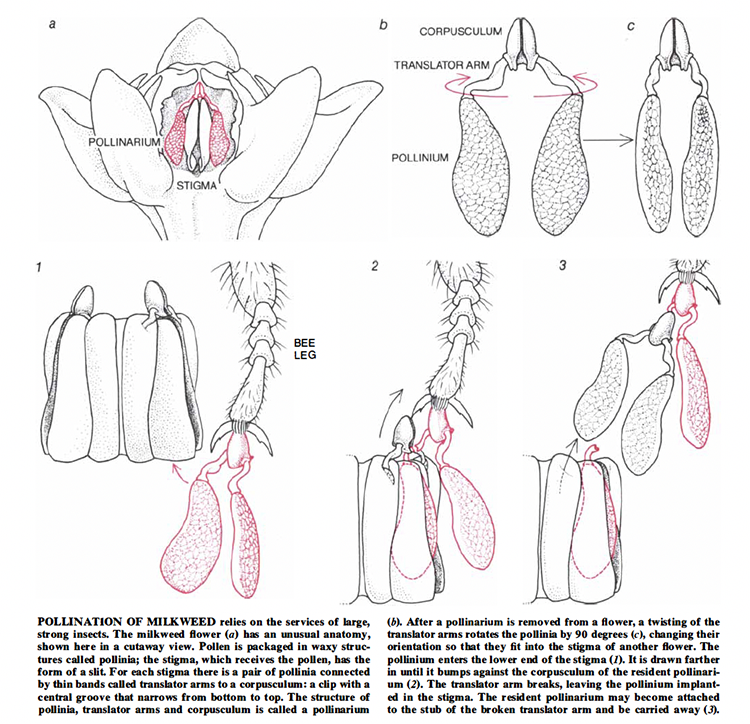
Thus those flowers with their corpusculum still in place have the greatest chance of being fertilized. This is why the numerous flowers result in only a few seed pods. The fact that the translator arms take a few minutes to rotate after being pulled from a flower prevents the insect from cross pollinating adjacent flowers and allows the insect to find other plants that may not be clones of the first plant the insect visited. [This summary is based on the research work of Douglass H. Morse of Brown University.]