These short articles are written to highlight the plants, history and lore of the Eloise Butler Wildflower Garden to past and contemporary events and may include personal commentary of the writer, not necessarily related to the Wildflower Garden. A web of present and past events.
May 2026
Articles
Banging your head without headaches
Trying the save trees - repeated frustration.
In case you missed it - superbloom in Death Valley
Banging your head without headaches
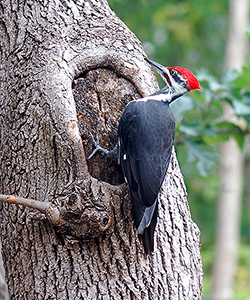
That’s what woodpeckers do - up to 13 times a second, time after time, without loosing their breath, without breaking their necks and without getting a headache.
All woodpeckers can generate boring and drilling forces up to 20 to 30 times their own weight. They do it by combining the action of all their muscles from head to tail using their hip muscles to push forward, stiffening the head and neck muscles, taking a breath and sharply exhaling as they strike. Then repeat, repeat, repeat.
Two researchers at Brown University, Nicolas Antonson and Matthew Fuxjager have recruited a number of woodpeckers, attached tiny tracking devices and recorded what goes on when they hammer away.
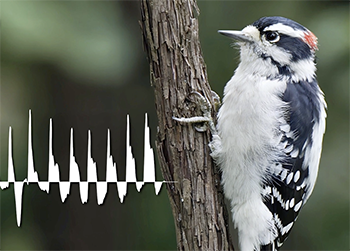
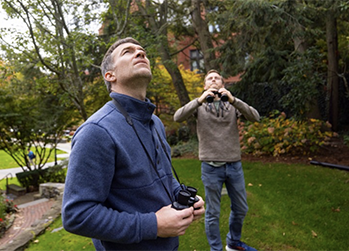
You can review one of their latest research papers in the Journal of Experimental Biology at this link. Antonson: https://journals.biologists.com/jeb/article/228/21/jeb251167/369678
You can review the video/audio file of breathing data from Antonson and Fuxjager's research with downy woodpeckers at this link: https://www.brown.edu/news/2025-11-06/woodpeckers-drilling-physiology
The Red Turtlehead
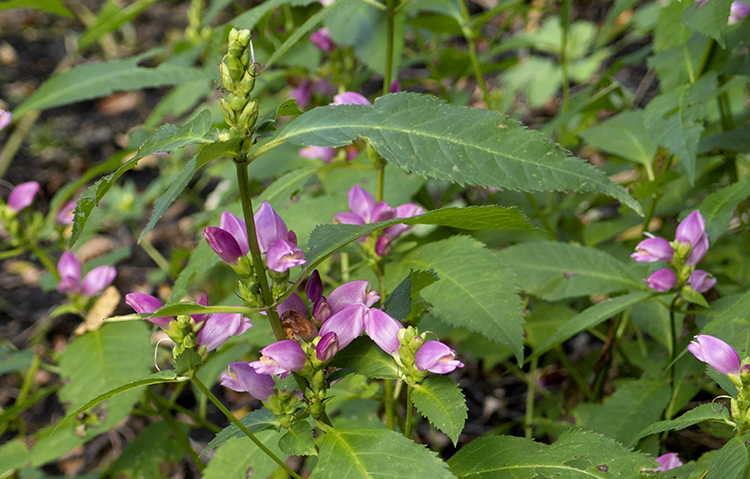
2026 is 100th anniversary of red turtlehead being added to the Eloise Butler Wildflower Garden by Eloise. There are only a few native wildflowers that look like this one.

A side view of the flower will explain the name and bumblebees know how to open the jaw and get the nectar. The plant’s height varies depending on how much sunlight it has - usually 2 to 3 feet but taller if it has to stretch.
It grows slowly over the late spring and summer and finally in late summer to early autumn the flowers form and open ranging from a light to a deep pink. The plants in the Wildflower Garden are a deep pink. Red Turlehead is a plant that appreciates wet soil and full sun although those in the Wildflower Garden do not get full sun and plants the writer has grown flower beautifully without having continuously wet soil.
A benefit for the home garden is that they are very deer and rabbit resistant. The leaves can vary in color from a nice dark green to medium green. Leaves produce two chemicals (metabolites) that deter browsers from eating them. Leaf color, leaf size and flower color depend on which of the 3 varieties of the species you have.
While they have been in the Garden for 100 years, with some replanting from time to time, there has been some controversy over the years about whether they are native and should be kept. Even if not native, beauty won out and the plants show their appreciation to visitors every year.
The University of Minnesota’s Checklist of the Vascular Plants of Minnesota still listed it as native but distribution in the state is not well documented. The more recent MN DNR county census does not list it. The history of the Garden plants leaves it open to speculation also. Eloise obtained them from the garden of Mr. Rohl, a Minneapolis Policeman who had gotten them from the vicinity of Waterville MN and naturalized them in his garden.
It is a question of whether the Waterville plants were native or escaped garden plants. Nevertheless, they were subsequently stolen from the Wildflower Garden and then replaced in May 1931 with more from Mr. Rohl and have been in the Wildflower Garden ever since. Look for them in late summer at the boardwalk bridge.
Here is a link to our full information sheet on the plant.
Trying the save trees - repeated frustration.
We start back in the 1970’s with the strategy to prevent dutch elm disease by injecting a preventative, usually Lignasan, into the trunk and root. We know now that not much could save the elm species that were susceptible to this pest and those stately trees are long gone from parks and city boulevards.
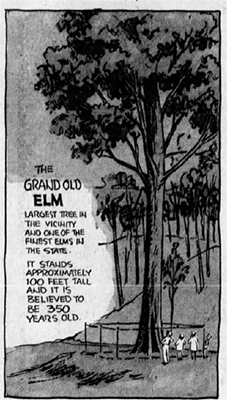
At the Eloise Butler Wildflower Garden the American elm was the predominant mature tree providing canopy cover in the woodland and in 1976 there was one particular elm that Gardener Ken Avery and the Friends board of directors wanted to save. It was just outside the Garden between the back gate and Xerxes Avenue near the existing walking path. It had a girth of 16 feet, 4 inches. Ken wrote that year:
“It seems that the company which does this commercially, however, has their equipment on trucks, etc., so that they could not get the equipment into the Garden to treat the trees there, but John Murtfeldt, who is in charge of this project, did get one company to treat this precious old tree. I suspect we have saved it - - at least for one year. If you haven't been down to see it, we lost about half of the remaining elms in the Garden this summer. It's a shame --- the Garden will never be the same!” (The Friends history 1976)
The treatment worked for a while. In 1978, in an interview, former Curator Martha Crone said “that it was one of two trees she remembers fondly. This was the elm just outside the Garden that was fenced in back in the days when Theodore Wirth and Alvin Witt considered it "their" tree. This is the largest elm remaining in the Park and with treatments by the Friends.” (The Friends history 1978)
We don’t know when it actually died and was removed but the stump has been visible for years. By 1980 the Wildflower Garden had lost all of its canopy elms.
The attempts to save the elms was abandoned after a time and that abandonment brings to mind the more recent attempts at chemical injection to save the ash trees from the emerald ash borer. This was big business for a while, but now 50 years after the attempts to save the elms, forestry departments and arborists are no longer recommending treatment for ash trees as the trees ultimately succumb. We have come full circle once again. A positive note from this is that the ash story has broken the old line of reasoning that had picked one predominant species to reforest an area.
A 1951 special tribute
On May 26 1951 the Minneapolis Tribute posted a short editorial about the Wildflower Garden.
It said this:

“A GARDEN is a lovesome thing, God Wot.”
And in this merry month of May let’s doff our hats to the home gardener, who makes our city bloom with clumps and borders and window boxes of gay flowers. Hats off especially to the women who toil seven days a week - planting, weeding, watering, spraying, cultivating and otherwise exercising their green thumbs to make our short season so productive of beauty. The site of a well tended garden lifts the spirit and makes us grateful that spring has come and summer is on the way.
But the woman to whom we doff our hats with the greatest respect cultivates almost single-handed a garden of some 13 acres. From the time she can push the gates open against the April snowdrifts she works there from 9 to 5 daily. Most of the time she is on her knees doing what other women are doing in their backyards.
Her name is Martha Crone and she is curator of the Eloise Butler Wildflower Garden in Theodore Wirth Park. From spring until fall this garden is a constantly changing panorama of Minnesota wildflowers, many of them extremely rare. It is the most unusual garden of its kind in the United States, a haven of peace and beauty. Best of all it belongs to the public. Ever been there?
A sedge worth considering - #2
We present the second of three sedges to consider for a place in any garden, particularly a native plant garden. Last month we covered Bottlebrush Sedge.
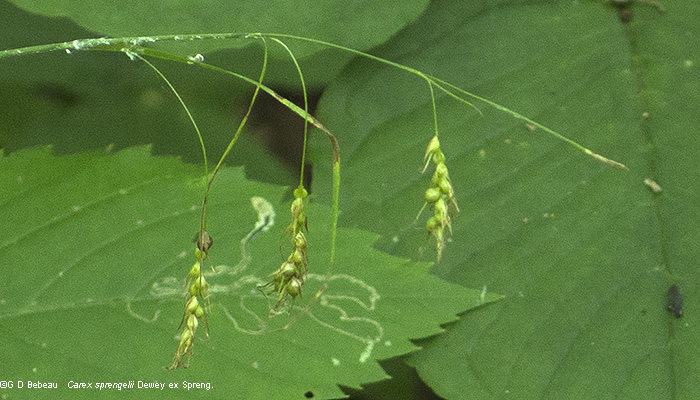
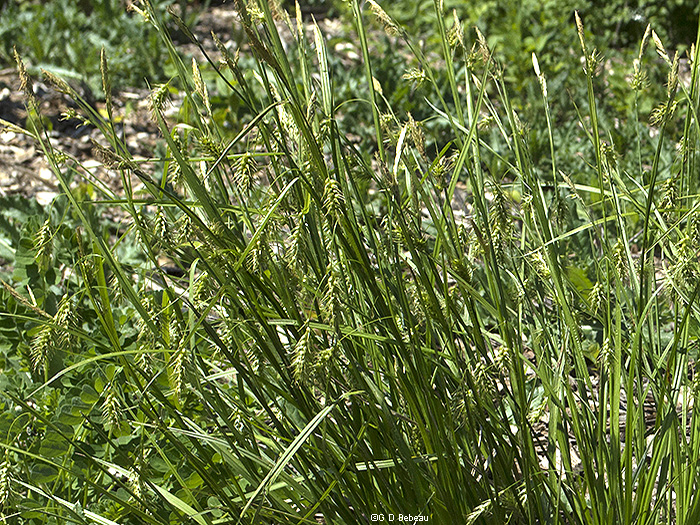
This month it is Sprengel's sedge, also known as long-beaked sedge (Carex sprengelii). Unlike last months suggestion, Sprengel's does not need continually moist soil. Sprengel's prefers mesic (not too wet - not too dry, well drained) conditions - partial sun to full shade. It is a cool season species, with bloom and finest appearances in May-June before the heat of summer. The stems and leaves are about 12 inches high. The flowering stems are longer and arch upward and over with the male spikes at the tip and 4 to 5 female spikes, widely separated, below them. This is what make the appearance of the plant so distinctive. See photo below which also shows the long beaks on the seeds which give the plant its alternate name.
Sprengel's is native to Minnesota and widespread. Only 4 counties do not report it. A large number of plants were added to the Eloise Butler Wildflower Garden stock in 2020. The species name is an honorary for Kurt Joachim Sprengel (1766-1833), a well published German botanist and medical doctor noted for his early studies of the fertilization of flowers by insects. After American botanist Chester Dewey wrote a classification for this plant, Sprengel decided it needed an update, did so, and is now recognized as the amending author of the classification.
By the way: Animals do not bother the plant and it transplants easily.
Here is a link to our full information sheet on the plant.
Update on CO-2 levels
Carbon Dioxide levels in the atmosphere continue to rise based on data from the National Oceanic and Atmospheric Administration’s (NOAA) Mauna Loa Observatory. April readings average around 431 parts per million. NOAA first measured this data in 1958 when the reading was under 320 parts per million. Chart from NOAA.

In case you missed it - Death Valley Superbloom
The flower bloom in Death Valley this spring was the best since 2016. These superblooms occur about once every 10 years when annual fall and winter rains are good and well spaced and there is an absence of strong winds.
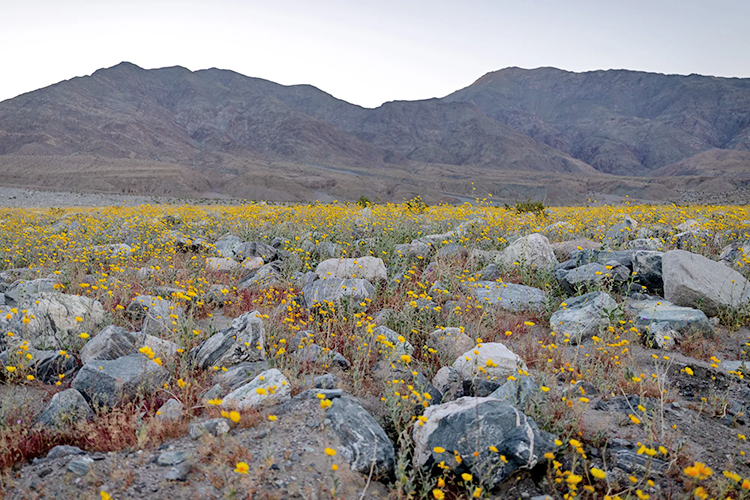
Photo- Eric Thayer, Los Angeles Times.
Historical Photo
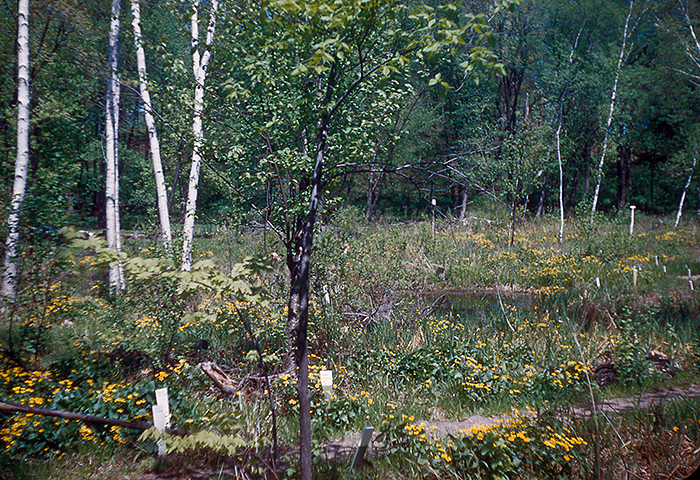
The wetland with marsh marigolds in bloom and open water in one of the 3 pools Martha Crone created in 1946/47. Photo ©Friends of the Wildflower Garden from a Kodachrome by Martha Crone, May 27 1950. This area is approximately on the west side of the large gathering area of the new boardwalk.