These short articles are written to highlight the plants, history and lore of the Eloise Butler Wildflower Garden to past and contemporary events and may include personal commentary of the writer, not necessarily related to the Wildflower Garden. A web of present and past events.
April 2026
Articles
The perfect late spring wildflower for dappled shade
The first Wildflower Garden history
The Garden is open
Come and visit. David Motzenbecker wrote in The Fringed Gentian™ last month:
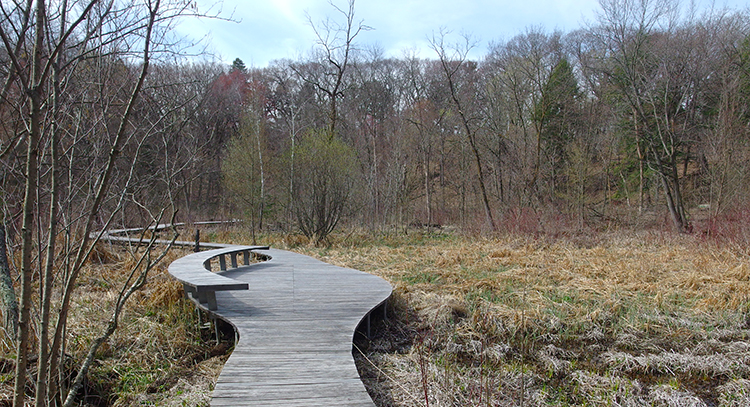
The forest does not move in straight lines. Neither do we. Our lives loop, cross, disappear, and return—like roots beneath our feet. What better place to cultivate this connection than within the gentle confines of the Eloise Butler Wildflower Garden. As its paths loop up and down, in their own circles and knots, they carry us into another world. This world of quiet birdsong and hushed breezes, waving prairies and interlaced canopies brings us calm. Take some time this season to be still and notice yourself as you wander within its embrace.
When you visit take a look outside the back gate to see the extensive renovation work done in the north meadow by the Greater Eloise Stewards over the past fall and winter.
The Maidenhair Tree
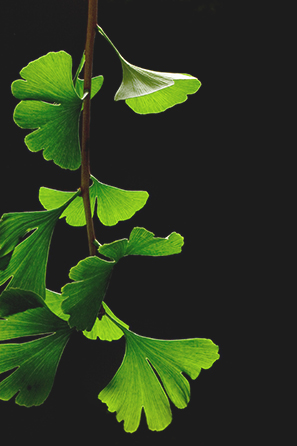
The Maidenhair Tree, otherwise known as the Ginkgo, Ginkgo biloba, had a brief residency in the Eloise Butler Wildflower Garden beginning in 1948. It was resident in Minneapolis before that. One of the Minneapolis trees was considered the champion Gingko of the city before it was destroyed by a tornado in 1981.(1) Today it is resident on certain city streets as a boulevard tree, particularly in Bryn Mawr.
The first two Ginkgos in the Wildflower Garden were planted in April 1948 by Martha Crone. They were listed on her 1951 plant census and in April 1958 she planted two more near the Garden’s south (main) entrance. At some unknown time thereafter they disappeared from the Garden census.
Martha Crone wrote a good description of the tree in 1956:
In the course of evolutionary history, groups of plants dwindle in numbers and leave behind but a single species to remind us of a once flourishing race. A good example is the Ginkgo, Darwin called “the living fossil.”
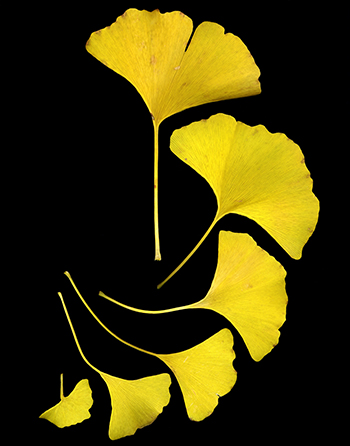
It is found in China and Japan grown mostly under cultivation reaching a height of 60 feet. It’s grown locally as an ornamental tree. Millions of years ago they were very abundant. They trace their ancestry directly back to fossils found among the first land plants of the mid Paleozoic Era. The fan-shaped leaves several inches long are similar in shape to the Maidenhair fern, which is the reason for its name. Their texture is leathery and the color is a yellowish green in summer turning to gold in the autumn. (2)
She later added these additional notes:

It grows very slowly and never becomes very large. After transplanting it seems retarded for many years. This is from personal experiences. [The US Forest Service states the same thing]
Some of its good virtues are being immune to insect pests and disease and needing very little care. Any soil is suitable for its growth and they are not affected by city dust and smoke. The seed produced by the female tree is surrounded by an odorous pulp and is most disagreeable. Since the tree is rather large before it bears [30 to 40 years old] it cannot be determined until too late what sex it might be. New York had this sad experience and many trees had to be cut down.(3)
The tree is dioecious, that is male and female parts are on separate trees and you need a male tree nearby for the female to bear fruit. The issue with the foul smelling fruit is resolved today as most nurseries only see grafted male cultivars.
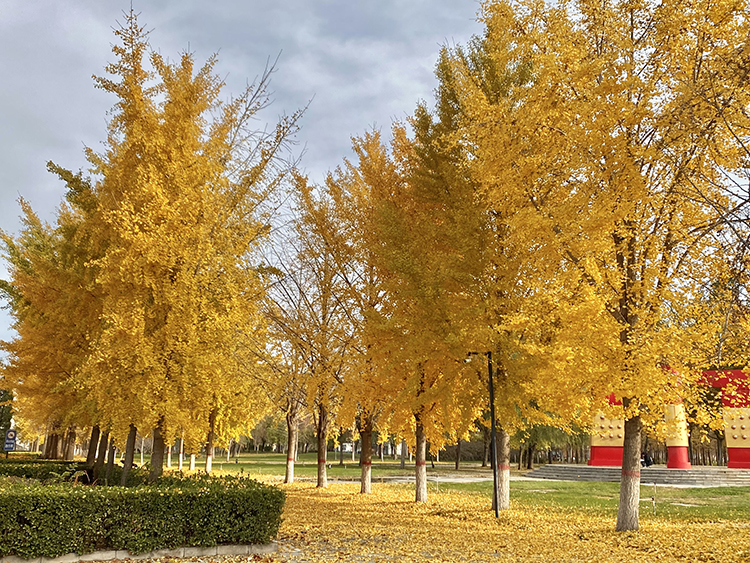
The fall color is gorgeous. The Ginkgo is hardy in USDA zones 3 to 9, thus surviving well in Minnesota. It is a landscape specimen worthy of consideration for planting at a residence or in city parkland. You will not find a listing on the National Champion Tree List as the list does not include introduced ornamental trees.
Below: Fall color of Ginkgos in Hebei China. Photo Benjaminm Ceci CC BY-SA 4.0
Notes:
1. Letter, May 9, 1985, City of Minneapolis, "The Minneapolis Heritage Tree Program".
2. The Fringed Gentian™ Vol 4 no.3 July 1956
3. The Fringed Gentian™ Vol 9 no.4 Oct 1961
The perfect late spring wildflower for dappled shade
Do you want a perfect native wildflower with low growth habit and lovely flowers for a dappled shade area?
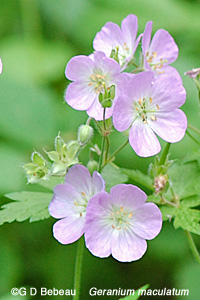
That plant is the wild geranimum (Geranium maculatum), which blooms mid-May into June, with stems 12 to 20 inches high with clusters of rose-purple flowers at the top, and the most interesting mature seed heads which resemble a wrought iron chandelier with five lamps. It is not aggressive, clumps enlarge and it transplants easily. Furthermore, it is deer resistant and bee friendly.
At Eloise Butler Wildflower Garden you will find large swaths of it in various places in the woodland with it is indigenous to the space.
Eloise Butler wrote in 1911:
"Few are unable to name the Wild Geranium when they observe the form of the leaf, the flower cluster, and the flower. This geranium enlivens large expanses of woodlands with its purplish flowers. The significance of another name - cranesbill - is seen when the blossom goes to seed, forming a birdlike beak, from the base of which uncurl fine little seed-like fruits." Sunday Minneapolis Tribune, June 4, 1911.
The root of the plant contain tannic and gallic acid and was used medicinally in dried and powdered form as an astringent and styptic. When dried the white internal parts of the root turn purple, have a strong astringent taste without odor. Frances Densmore in her study of the Minnesota Chippewa reports usage of the dried and powdered root for treating mouth sores, especially effective for children.

The first Wildflower Garden History

Would the public like to see a history of the Wildflower Garden? Would the public be interested in a plant census of the Garden?
Yes! as Martha Crone told the Park Superintendent. Visitors were asking for it and she requested that it be developed. (Report to Charles E. Doell, January 20, 1950 ) She actually had to produced it herself, first by introducing a small brochure in 1950 and then 75 years ago, in 1951, she wrote a 4-page history of the Eloise Butler Wildflower Garden and printed it for visitors. Then she added a plant list that was available to visitors for 10 cents. The list contained 787 species of forbs, ferns, shrubs and trees, excluding grasses, sedges, mosses, fungi, etc. The plant list was compiled in plant family arrangement, which made a list index necessary for non-botanists who might know the common name or even the scientific name, but probably not the plant family. Her first version did not include that index and when non-technical visitors asked for an index, she added it.
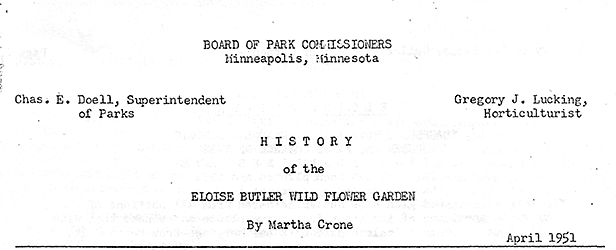
This was the first census since the botany teachers original 1907 survey of the Garden and involved a tremendous amount of effort. Another significant census would not be done until 1986 when Barbara Delaney from the University of Minnesota completed a census in preparation for the issuance of a new Garden Guidebook
Martha Crone's 1951 History of the Wildflower Garden.
Martha Crone's 1951 History with the plant census.
A sedge worth considering
Some native plant gardeners consider sedges to be "nondescript" and thus an avoidable species for a garden. But for a moist area of a wildflower garden there are few plants easier to grow. Although, it would be nice to have one that has some “descript” about it.

Here I introduce the bottlebrush sedge, Carex hystericina.
Bottlebrush Sedge is clump forming from short rhizomes. It grows in swamps, marshes, moist swales where it has moist conditions, wet to wet-mesic, full sun only. It has low drought and shade tolerance. I must add that you do not really need a marsh, just an area that is usually moist or can be kept moist and it will be happy.
The name “bottlebrush” comes from the flower bearing inflorescence atop the flowering spike. This structure can be 2 to 3 inches long and have the appearance of a bottle brush caused by the spikes sticking straight out from the tips of the seed bearing structures which are called 'perigynia'. This layout also explains the species names with is derived from hystrix, meaning 'bristly' or 'porcupine like’.
Bottlebrush sedge is indigenous to Eloise Butler and is still present today. Sedges have fibrous roots and transplant easily so large clumps can be divided and transplanted.

Historical Photo
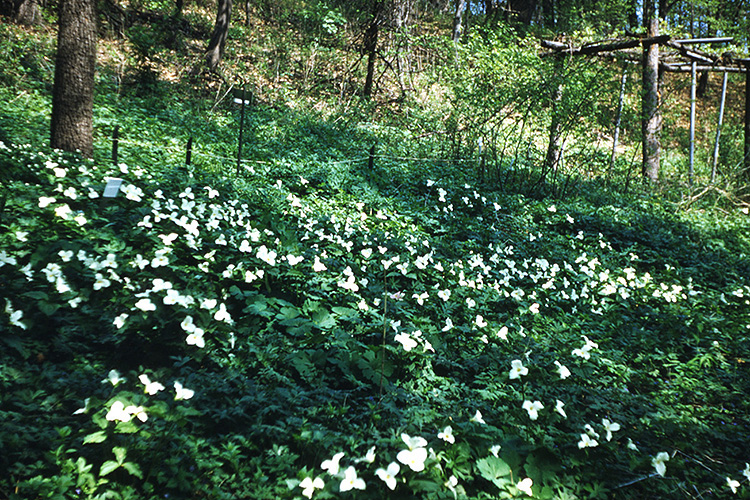
A large grouping of large-flowered trillium (Trillium grandiflorum) in the woodland garden. Photo ©Friends of the Wildflower Garden from a Kodachrome by Martha Crone, April 29, 1949. This day is matches the historical average flowering date in the Wildflower Garden for this species. Its earliest recorded bloom was April 10 in 1981.