
Friends of the Wildflower Garden
Eloise Butler Wildflower Garden & Bird Sanctuary
Eloise Butler Wildflower Garden Fencing
Historical Details: 1924-2024
The 1924 Fence

In order to really secure the Garden from large animals, vandals and people that just wandered in from all directions, it had to be securely fence and equipped with gates that could be locked. Eloise Butler even resorted to the newspaper on three occasions to state her case for a fence.
Prior to 1924 the Park Board could not allocate funds to add fencing. A fence for the original 3 acres was required by the 1907 Board action creating the Garden. In Martha Hellander's book The Wild Gardener, she, at one point says the Garden was unfenced (1, pg. 79) but on another page (1, pg. 85) says there was an original enclosure of 3 acres. Although Hellander gives no reference for her “unfenced” statement, the original 1907 fence around the 3 acres would have been south of the tarvia path (sometimes referred to as a road) in what is now the current Garden space and what was then the original 1907 part of the Garden.
As early as 1912, Eloice Butler saw the need for more fencing. She wrote for the 1912 Annual Report of the Board of Park Commissioners: The labor of the curator would be materially brightened if the garden were fenced and more warning signs posted. She reported that her work consisted of conducting visitors, exterminating pestilent weeds and protecting the property from marauders. "For ‘tis true, ‘tis pity, and pity ‘tis, ‘tis true' that a small proportion of our citizens have not yet learned to name the birds without a gun, or to love the wood rose and leave it on its stalk."
Ms. Butler's worst menace was "spooners." A headline in the Minneapolis Tribune on September 18, 1921 read: "Glenwood Park Wants Wire Fence to Keep Out Spooners." The article explained Ms. Butler's thoughts that cats and dogs may leave a trail in the vegetation but spooners were the real problem. The full text read as follows:
It’s not the wild, voracious mosquito-
It’s not the snooping vagabond dog -
Nor is it the pussy-footing feline -
But it’s the demon surreptitious spooner that's brought the need for an encircling barbed wire fence around the wild flower garden in Glenwood Park to save plants of incalculable scientific value from destruction. A stray cat will pitter patter into the garden and leave a narrow trail. A dog seeking food perhaps in the shape of a ribbit (sic) will snoop through and leave a wider wallow -
But the spooning couple -
(Eloise Butler quote) “For destructive properties the army of tussock worms is a piker when compared with the Spooner” (2)
On June 22 the Minneapolis Star Tribune published a short article titled "Flower Garden Director Urges Fence be Built." Eloise stated that the collection will be ruined unless a fence is built around the property at once. Theodore Wirth was quoted as saying the the approximate expense would be $600 but there were no funds available. Eloise said "I will pay for the building of a fence myself, if necessary to save the collection."
Later in the year, while the fence work was in process, in another newspaper article (pdf copy) she was quoted saying “The fence is needed to keep our the few vandals who destroy in a few minutes the work of years and spoil the garden for the rest of the visitors.” The article concluded - “Tired of waiting years for it to be built, she finally is having it put up herself.” (3)
Thus, in the summer of 1924, Eloise contracted, at her own expense, to have the fencing completed for a sum of $696.10. She paid $400 down, gave a note for $200 to be paid within a month or when the fence was completed, and the final amount by a note to be paid in the spring of 1925. Eloise wrote that the fence was not completed prior to her annual Winter return to Malden Massachusetts in October. (4)
One set of fences or two?
Written evidence for two fences: Eloise could not afford to fence the entire area of the Garden as it totaled about 25 acres at that time (1, page 155)(5). Based on Butler's log notes, after 1924 she had two enclosures which she referred to as the North Enclosure and the South Enclosure, the north protecting the wetland orchids, both referenced with a “brook” running through them. These enclosures would have been on the north and south sides of the tarvia path that bisected the area from east to west. (See Garden Pools article for path detail). She writes on July 16, 1924 "Lady Slipper meadow enclosed today, fence not yet completely braced." That meadow was in the northern part of the Garden below the outlet channel for the dam, built by Eloise, that formed a small open pool in the original southern part of the Garden. On July 20 she began planting near that fence; she wrote "Planted from Glenwood Park, 51 Aster azureus near southeast gate of lady slipper enclosure." She noted on August 1st planting in the “north enclosure.” This would imply that there was another enclosure, more southern, but she does not mention actually planting anything in this “south enclosure” by name until October 8, 1925, although there are numerous entries in the log prior to that of planting “near fence” without stating which fence. (4)
Hellander further states (1 pg. 85) that Eloise enclosed 5 acres in the north meadow area of the Lady's-slippers in 1924 but she does not give a source for that statement, so we are left with this conclusion: The original 1907 3 acre fence, if there was one, would have been in the southern enclosure, south of the tarvia path that bisected Butler’s Garden of 1924. It was only after 1907 that the area of the north meadow was added to the Garden. So, Eloise had two enclosures built in 1924 - the one in the north meadow, north of the tarvia path and one south of the tarvia path - perhaps adding to the original 1907 fence, if there was one, or completely replacing it, but still concentrated in the wetland part of the Garden based on Butler’s statement about a brook running through both areas. Further confirmation that there were two Garden areas separated by the tarvia path is contained in Butler's 1926 submission to the bulletin circular of the Gray Memorial Botanical Chapter. This article discussed the trees of the Garden and she states in one section about a Balsam Poplar that "It is planted near the gate on the south side of the tarvia road that divides the precincts."
It was within the "north enclosure" that the Mallard Pool was constructed in 1932. She noted in her log on July 7, 1932 "Mallard Pool completed in north enclosure." That places the "north enclosure" north of the current back fence of the Garden in the wetland area that was once part of the Garden and has now grown wild. Details on the Mallard Pool in this article.
Back in Malden, Eloise wrote to the Crones (Martha and William) that she had informed Park Superintendent Wirth about what she did and never asked for reimbursement. She was pleasantly surprised to receive a note from him promising a check for the full amount by early December. Thus she says “You may believe that I am very happy.” (6)
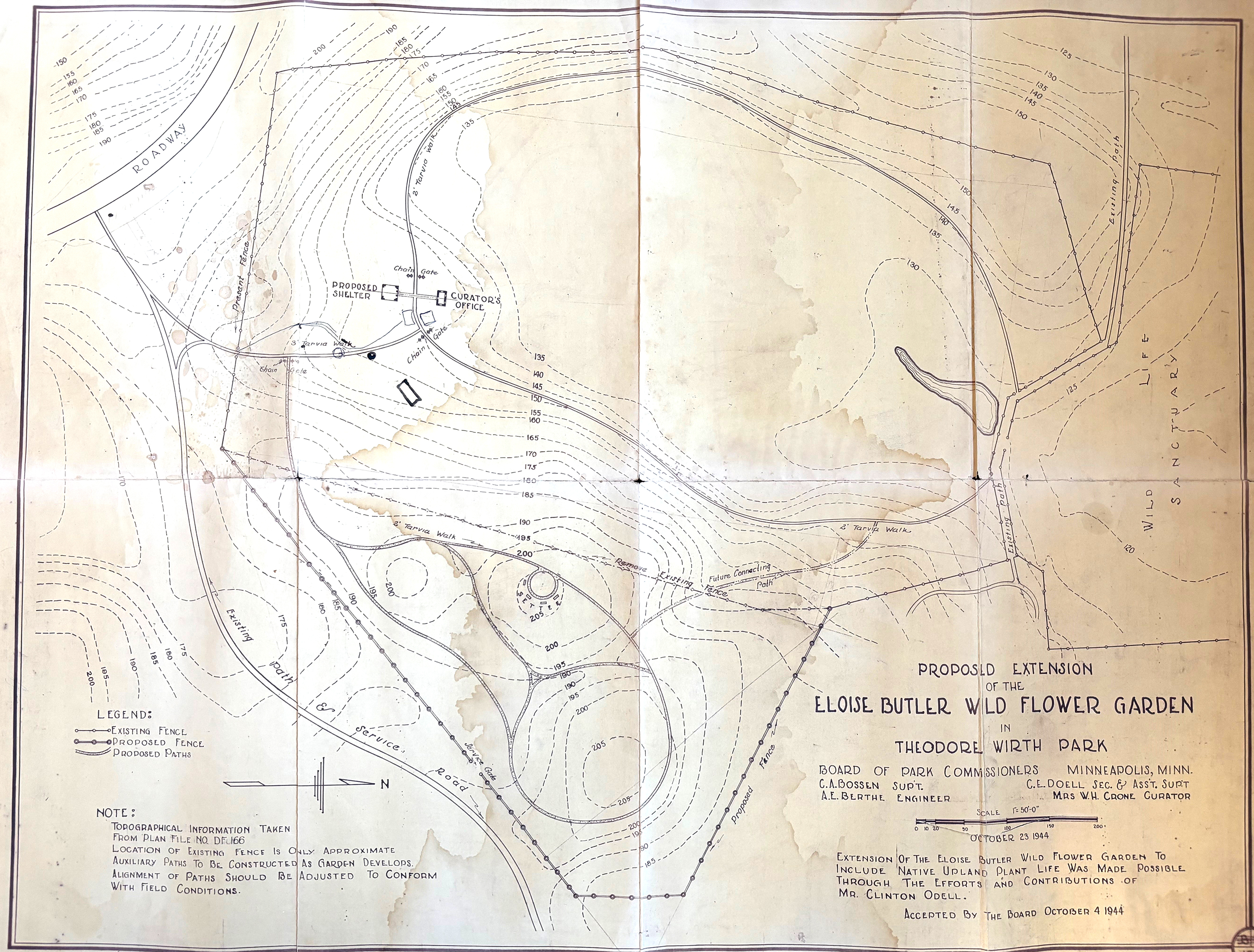
Photo and map evidence for two fences: Several photos are available from the 1930s that show two sets of fences. In addition both the site plan blueprint and the survey drawn by the Park Board for the addition of the upland Garden in 1944 clearly outline a fence on both sides of the bisecting tarvia path.


1938 and Later
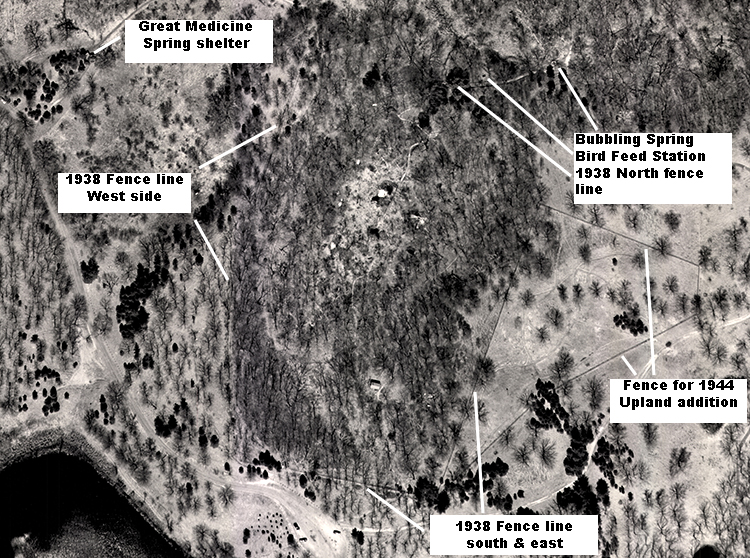
Some of the Eloise Butler's 1924 fencing may have been of a temporary nature or just worn out because in 1937 Martha Crone added this to her annual report to the board of park commissioners: "Greatly lacking is an adequate fence enclosing the reserve, as the present one is so run down and time worn as to be of little service." (December 10, 1937). In quick response, in 1938 a permanent chain-link fence was built by a WPA crew in the southern part of the Garden. Although some records state that 1,900 linear feet were installed that is hardly enough to enough to enclose about 5-1/2 acres.(7) However, aerial photos from late 1938 show a new fence, highlighted by a snow line, enclosing what was then the Garden Martha Crone tended, about 9 or 10 acres - that is the portion south of the tarvia path, which was the southern part of Eloise Butler's 25 acres which had also included the northern meadow and adjacent areas. (see photo below) The new fence was six feet high and of wire mesh, with 3 gates for entrance.
All that today constitutes the Woodland Garden seems to have been fenced in, the amount of fencing was obviously much more than the 1,900 feet reported. There is no record yet found that speaks to a later replacement until the expansion of the east side boundary in 2022 and 2024. It was reported that Clinton Odell paid what the costs were to put in the fence. (7a) On January 18 1939, Martha Crone wrote that the Park Board workers were in putting in a new fence in the "lower enclosure" which would seem to be the "North enclosure" as the North section of the Garden is of lower elevation. (8) That 1939 fencing was then a replacement for the old fencing on the north side of the tarvia path along the back of the Garden and at each end included a projection that extended into the north meadow but did not form a complete enclosure (see survey and site plan).
Below: The 1938 Fence, just completed, erected by a WPA crew. Photo ©Walter Dahlberg.

Below: This spring 1947 aerial photo of the Garden area shows the main features of the area and the fence lines of the 1938 fence and the new Upland Garden fence. Detail of the northern area shown below. North is up in the photo. Photo Courtesy University of Minnesota.
The Upland Garden

In 1944 Clinton Odell proposed to the Park Board to add an upland area to the Eloise Butler Wild Flower Garden, Martha Hellander’s research found that Odell said to the Park Board that the northern area (which included the Mallard Pool) should never have been fenced and that it was swampy and should be abandoned in favor of an upland area which the garden did not have at that time (1, page 104). As we note in a separate article, this is the point in time when the entire northern meadow was abandoned as part of the Garden.
In her Annual Report to the Park Board for 1944 [February 20, 1945], Martha Crone wrote “The proposed extension of the fence enclosure, made possible through the efforts and contributions of Mr. Clinton Odell, to accommodate native upland and prairie plants will fill a long needed want. It is greatly appreciated and further development of this project is looked forward to with great interest.”
Martha Crone's 1952 map, courtesy of J. S. Futcher.

The 1939 fencing in the lower (northern) enclosure is the fence that that is partially shown on Martha Crone's 1952 map that was part of her Self-Conducted Tour brochure (image above) and on the 1944 site plan (image above) and survey (image below) for the Upland Addition. Her map shows the bird feeding station at the back gate with a triangular fence around it. The bird feeding station that was on the north side of a long fence which paralleled the tarvia path (see 1936 photo above and aerial photos above and below) now becomes separately fenced in. The aerial photo from 1947 shows this arrangement. A person knowledgeable about that bird feeding station and the area in the 1950s, Mr. J. S. Futcher, wrote that the bird feeding station was fenced separately and that there was also a large birch swale in that area that was fenced.(9) Later he states, the birch swale fencing was removed, he believes in the 1950s, leading to the deterioration of the area. We have photos by Martha Crone from 1948 and 1951 showing an extensive grove of birches. The map and drawing indicates he is speaking of the northern area sometimes referred to as the "lower enclosure" or the "north meadow" - the area where Eloise Butler constructed the Mallard Pool.
Below: The actual 1944 survey map of the existing Wildflower Garden and proposed changes for the upland addition. North direction is to the right side of the survey. You can see illustrated the existing fence line in the northern (or "lower") enclosure. There is a notation in the lower right corner referencing Clinton Odell. Some of the proposed infrastructure was never built. Map courtesy MPRB archives. [Larger map image]


Below: Aerial photo detail from 1947 showing the fence line at the northern end of the southern enclosure, south of which is the 1947 Garden and north of which is the abandoned Northern Meadow. Photo courtesy University of Minnesota.

Gardener Cary George remembered that at least some of the chain link fencing that was used in the northern enclosure was removed at some point in time and used to fence the new upland addition, because in 1944 wartime shortages of steel precluded new fencing being obtained (Conversation with author on May 18, 2018). Presumably there was a garden record of this, but it may have been related to him by his predecessor Ken Avery who worked for Martha Crone for 4 years before taking over from her. Perhaps though, some of the fencing was not removed until the early 1950s as Mr. Futcher remembers (see above notes). We do know that no fencing was done in the upland until after the war in Europe was over in 1945 but by the time of a 1947 aerial photo it was fenced. (see Upland Garden Addition)
The barbed wire at the top of the fence was added in 1989 to prevent deer from jumping over.(10) Some of that chain link fencing has been replaced - principally in the area in the front (south) of the Garden where wrought iron fencing was added in 1990 when the front gate was redesigned, then more along the front approach to the gate in 1995. Also when the back gate area was reconstructed between 1991 and 1995, The Friends funded the wrought iron fencing and the construction of the front and back gates. [Details] Then the expansion of the east side in 2022 and 2024 added new taller fencing replacing the old cyclone chain link fence.
Later Changes
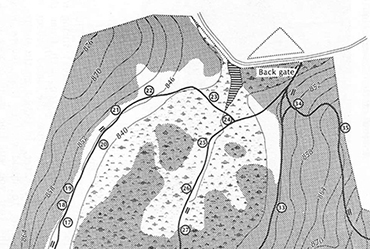
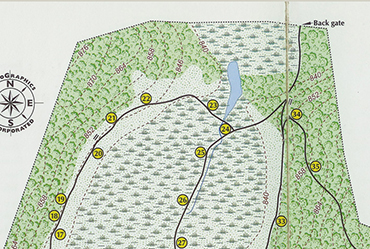
A realignment of the Garden's back fence. was completed in 1992 when a new back gate design was conceived. The maps shown below show the changes at the back of the Garden. In the 1987 map we still see that the old fence angled southward to where the dam was before reaching the back gate. The old tarvia path, going back to Eloise Butler's time, is shown following the fence line. The old dam dating back to Eloise Butler's time was kept in the same place but the old concrete was replaced with a natural looking rock dam.
In 1993, the Friends petitioned to have an additional acre added to the Upland Garden. This was approved and enough fencing to enclose that was obtained by removing the old chain link fence that still ran across the hillside forming the separation between the old Garden and new 1944 Upland addition. The fence work was done by Able Fence Co. hired by the Friends for a net cost of $3,695.
The 2001 map shows the fence realignment with the fence moved northward, creating an open area between the dam and the fence. The old path outside the Garden space was moved to follow the new fence line. It is evident from viewing the texture and condition of the current path along the realigned portion of the fence that it is of newer age. Also there is an abrupt directional intersect of the old tarvia path, coming from the northeast toward the back gate, with the newer portion and the difference in pavement age is evident. The bird feeding station now under goes its third iteration - it was removed from the north side of the tarvia path and a new elevated bird feeder was placed inside the Garden fence.
Below: 1st photo - the 1987 map section of the north end of the Garden. 2nd photo - the 2001 map showing the realignment of the fence. Maps courtesy Minneapolis Park and Recreation Board.
Below: This aerial photo from 1993 shows the re-aligned back fence with water in the newly dredged pool. The back gate has not yet been reconstructed to the current configuration - that was done in 1995.
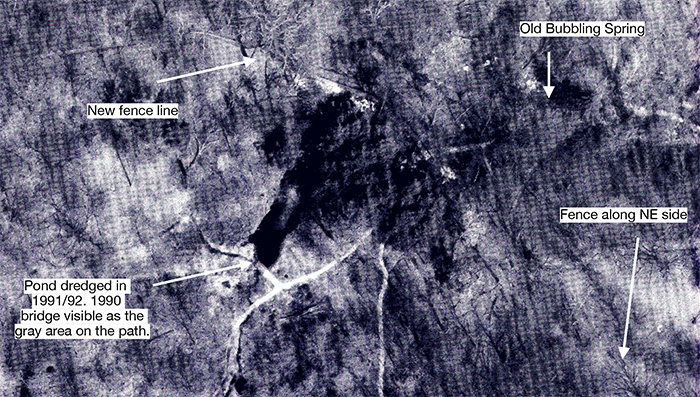
Once the fence was realigned and the the new back gate completed in 1995, some of the same wrought iron fencing was used near the gate and finally the entire back side (north) was replaced with wrought iron in 2005 - all funded by The Friends.

2022 Expansion: During the fall and winter of 2022 the Minneapolis Park & Recreation Board moved the perimeter of a section of the upland eastward enclosing, with a new fence, a heavily wooded area in the Volunteer Stewardship Area that had been cleared of invasives by volunteers of the Friends Invasive Plant Action Group (FIPAG) and Garden Legacy Stewards. This added almost another acre to the upland. The new fence was built higher, at eight feet, to deter deer from jumping into the Garden. New shrubs were added near the fence by the volunteer crews. These were surrounded with metal cages to prevent browsing damage. (photo below)

2024 Expansion: The most costly project for the Friends since Phase II of the wetland boardwalk in 2019 was competed in November. The new fencing in the upland replaced all the old 1946 cyclone fence on the upland side of the Garden from the point where the MPRB fence work ended in 2022 all the way to the back gate path. In the process, the perimeter of the Garden was extended outward to incorporate an area that had been cleared of invasives over the past 15 years, adding several acres to the Garden. The diagram map indicates the approximate new perimeter. Total cost - $95,533.


