
Friends of the Wildflower Garden
Urban Dragonflies
All of these can be seen in the Minneapolis/St. Paul metro area


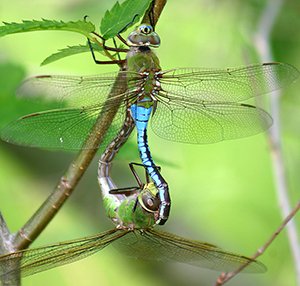
Green Darner Dragonfly
by Diana Thottungal, Naturalist
Fall is here and so is migration season. Birds and Monarch butterflies are well known migrators partly because they fly in swarms. They are also large and colorful, which also makes them easier to observe. Here is something a little bit different.
The green darner (Anax junius) dragonfly also heads south in the fall when the daytime temperature is in the vicinity of 45 degrees. However, they do not come back in swarms, making them more elusive. It will take at least three generations for the offspring of a green darner to make it back to its grandparents' southern breeding ground during their annual migration. Attached micro-radio transmitters have shown that they can travel around 10 miles per hour and go 87 miles a busy day.
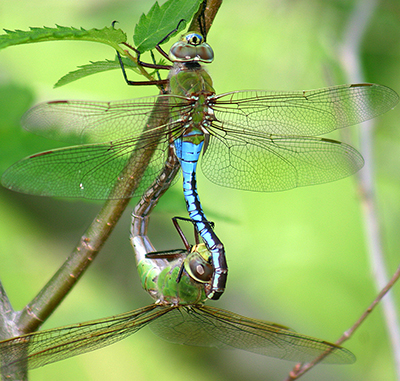
The migration of the green darners is not without its perils. Hawk Ridge in Duluth is named for its migrating raptors. Yes, they eat the migrating insects including green darners, especially kestrels. During very hot sunny days they raise their abdomens in order to be perpendicular to the Sun. That way they absorb less heat. Neat.
In addition to the multi-step reproductive cycle, the green darner dragonfly has an interesting way of eating. It shoots its mouthparts out in the direction of its intended prey. Not very far, just as though it is turning its mouth inside out and sideways so the jaws are effectively left and right instead of top and bottom.
They are also very active hunters. They close on the hapless victim with a vigorous snap. What are these hapless victims? With great frequency it is a mosquito or a mosquito larva. Since the dragonfly larvae are aquatic, they definitely help.❖
Editors Notes: Dragonflies belong to the class Insecta and the Order Odonata which includes both dragonflies and damselflies. Dragonflies tend to be larger and have large eyes which meet in the center of their heads. The wings of dragonflies are transparent with assorted markings. They are not narrow at the base and the forewings and the hindwings are each shaped differently. When at rest, the wings are outspread. Damselflies are generally smaller than dragonflies and have a more slender body. Their eyes are widely separated, and they hold their wings together above their body when at rest. [Source - Minnesota DNR]
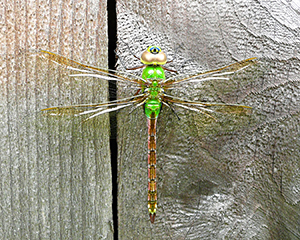
Below: Green darner at rest - wings outspread. Photo by Chuck Evans Mcevan CC-BY-3.0

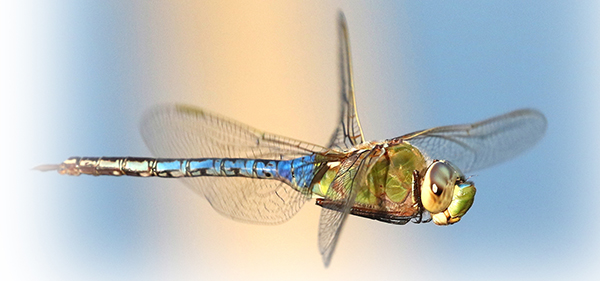
Photo top of page - common green darner hovering over a pond. Photo by Peter W. Chen CC BY-SA-4.0
Inaturalist reports that 148 different dragonfly and damselfly species have been observed in Minnesota.
This article originally was published in The Fringed Gentian™, Vol. 70 No.3, fall 2022