President's Letters 2025
As published in The Fringed Gentian™.
Spring 2025
Volume 73, No. 1
Dear Friends,
Have you visited the Friends of the Wildflower Garden’s website (friendsofeloisebutler.org)? If not, why not, and what are you missing?
In the twelve months starting with January 2024 through December 2024, there were 192,578 unique visitors to our website’s pages!!! The total number of website visitors was double that, and the total number of html pages viewed was almost a million! Of those viewing the website pages each month, 42-75% were from the United States. In August 2024, 70% of the html pages viewed, mostly plant information, were accessed by Americans, with the remainder accessed from Canada 5.8%, China 5.5%, Poland 4%, Germany 2.8%, United Kingdom 2.1%, Romania 1.8% and the Russian Federation 1.7%.

The Friends’ website was started in 2007, and Gary Bebeau has been the webmaster from its inception. Since 2001, Gary has served on the Friends’ Board of Directors and as Treasurer. Thank you, Gary, for your photographs, hard work, and dedication.
Clicking on the eight headings gives you the story of the Friends, Eloise Butler, and the Garden, as well as how to support the Garden and volunteer. The 669 Garden plants listed have photos and links to detailed information, including their history.
Of the 1,887 unique text pages on the website, 76% were accessed each month in 2024. 93% of these unique pages were either history or plant information. There are also 850 pdf documents. The website’s seven pdf books were downloaded 2,559 times!
The Friends’ Fringed Gentian™ newsletters beginning in January 1953 to the present are available on the website. If I search Witch Hazel and Fringed Gentian, it yields 47 references.
In 2024 The Fringed Gentian™ webpage version was accessed 1,918 times, but the most recent Fringed Gentian™ pdf was downloaded 208 times, while older Fringed Gentian™ pdfs were downloaded 25,947 times!

The plant information, photos and history on the website are phenomenal. For example:
“Skunk Cabbage is a plant of bogs and wet stream edges. Eloise Butler wrote: ‘The Skunk Cabbage is one of our earliest spring flowers, for it literally thaws through the soil of the icebound marshes. The bud expands into a clump of large leaves, from which the name cabbage is derived. The disagreeable odor is attractive to flies, which find a shelter from the cold within its purplish-red, hood-like spathe and pay rent by pollinating the flowers. The spathe - the showy part of the inflorescence - is merely a large leaf en-wrapping numerous minute flowers set on a fleshy axis.’ Eloise Butler’s records show that she obtained plants of Skunk Cabbage on June 3, 1907 from a site near the Lake Street Bridge in Minneapolis.”
Enjoy the spring, explore our website, and discover The Fringed Gentian™ and Twigs and Branches.
Jennifer Olson ❖

Photos G D Bebeau
Summer 2025
Volume 73, No. 2
Dear Friends,
This spring I discovered a Spring beauty, Claytonia virginica, which has long, narrow leaves and a half-inch flower blooming in my garden. I hadn’t planted it, but I was delighted to find it.
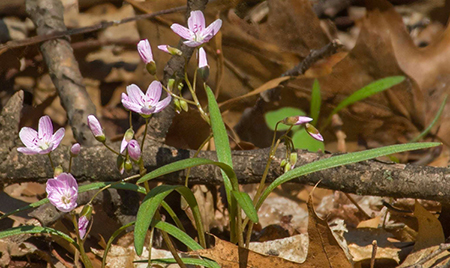
Spring beauty was last planted in the Eloise Butler Wildflower Garden in 2016 and it has only intermittently bloomed, but this spring it displayed a vigorous patch. The flowers were a distance from the path, so this half-inch blossom was best seen with binoculars.
Eloise Butler introduced Virginia spring beauty to the Garden on several occasions in the early years, starting in 1907, when on June 3rd she transplanted a clump sourced near the Lake Street Bridge in Minneapolis. Eloise Butler wrote in her 1911 newspaper article: “The spring beauty is local, but it brightens large patches of low woodlands, which it chooses for an abiding place. Spring beauty of Minneapolis is a low, slender plant with narrow leaves which come from a dark brown triangular tuber embedded in the earth. The flowers are dainty white bells striped with pink, and in masses thickly carpeting the earth are a joy to the eye.”
Virginia Spring Beauty which has narrow leaves.
Below left: Grouping - photo Bob Ambler. Right: flower detail - photo G D Bebeu.
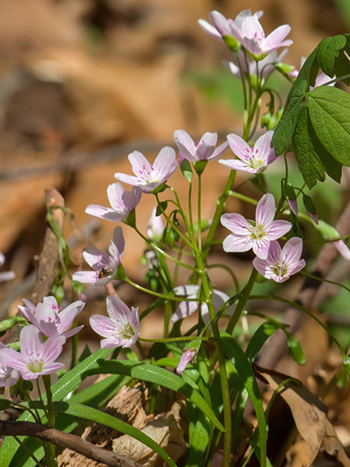
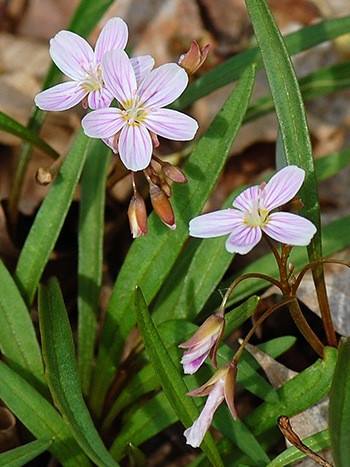
Eloise planted it six more times and planted Carolina spring beauty in 1912, but it was never included in the later census. Martha Crone, Cary George, and Susan Wilkins planted Spring beauty repeatedly. As with many spring ephemerals, dry spring weather and hot summers can wipe them out. Claytonia caroliniana blooms in the Arrowhead area near Lake Superior, while Claytonia virginica inhabits the east side of the state north of the metro area and in counties in the SE section south of the Metro.
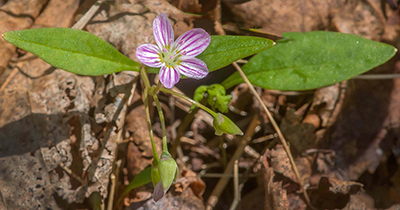
The author Phyllis Root’s book published seven years ago, Searching for Minnesota’s Native Wildflowers with beautiful photography by Kelly Povo, describes the Spring beauty as one of Minnesota’s true spring ephemerals. A true spring ephemeral blooms briefly and then vanishes completely, leaves and all, like the Garden’s three trout lilies.
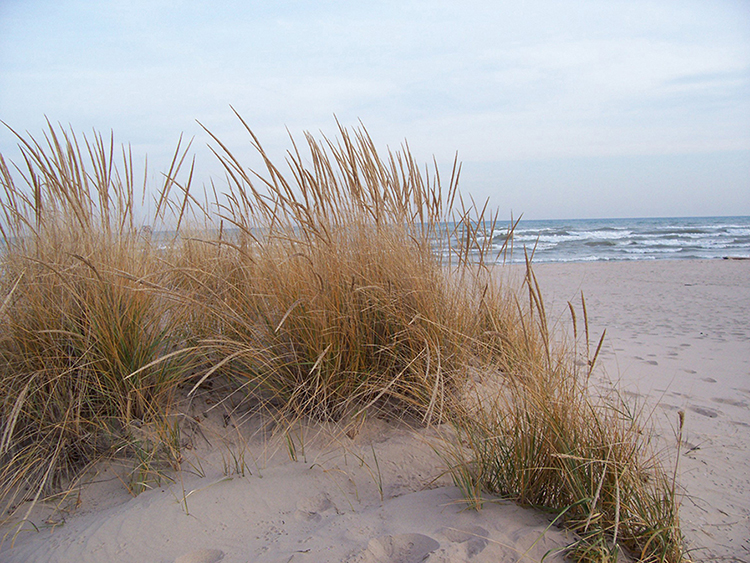
Root’s and Povo’s new book, Chasing Wildflowers, is now available. It presents 185 wildflowers in 11 microhabitats ranging from the North Shores to Minnesota’s wetlands, woodlands, rocky outcrops, floodplain forests and even road ditches. Only about 6% represent plants in the Eloise Butler Wildflower Garden. One year the authors drove over 12,000 miles chasing wildflowers, with their packed bug shirts, insect repellent and good rubber boots in the trunk! On my next trip to Duluth, my goal is to go to Pine Point, the only place in Minnesota to see the state-threatened American beach grass.
Spring has passed quickly and soon the Showy lady slippers will bloom and the Upland Meadow will turn purple with the False blue indigo. Search and Find your Favorite Wildflowers.❖
Jennifer Olson
Below: Jennifer's next plant quest: American Beach Grass, Ammophila breviligulata ssp breviligulata shown here on the Lake Michigan shoreline in Wisconsin. Photo - RoyalBroil CC BY-SA 3.0
Fall 2025
Volume 73, No. 3
Dear Friends,
Autumn is here, all varieties of asters are blooming, and leaves are falling onto the trails. The Garden season will end on October 26. But with two anonymous donations to the Garden, winter programming will be funded at the Loppet, and plant data beginning from 1907 will be entered into Hortis, a modern platform for managing botanical collections.

A big THANK YOU to the Garden naturalists who do so much for the Garden. This year, core naturalists Debbie, Keygan, Lisset, and Linette staffed the Visitor Center with backup from Cheyanne, Jodi, Katie, and Maria. They also led tours, planned and set up educational displays in the Visitor Center, and worked special evening programs including two evening Firefly Programs with 550 participants!
Naturalist Tammy leads the Early Birders on Saturday mornings and Kim, Garden Program Director, coordinates the educational programs. Debbie says “I love it that working at the Garden is a constant learning experience and I can share that with visitors and deepen our connections with nature!” Keegan, listening to a hooting owl, “appreciated a visitor’s approach by quieting other nearby visitors, so everyone could enjoy the owl.” Lisette loves being in the Garden to view the birds. Her favorites are the hummingbirds and catbirds! She is responsible for the wetland’s catbird signage!

This summer at the Kiosk, the Touch and Feel items included a gall–small, hard and tan. After my shift, I walked through the Upland Meadow and spotted a goldenrod gall. I took my photo to the Visitor Center and not only did the naturalist confirm it was a gall, but also showed me their informative gall exhibit!
While the other galls discussed in this display are found on woody plants, herbaceous plants are also affected by gall-making insects and mites. A common example is found on late goldenrod (Solidago altissima) and giant goldenrod (S. gigantea).

Hackberry Blistergall and Nipple Galls have similar life cycles with adult insects overwintering before emerging in spring and laying eggs on hackberry leaves. The immature nymphs develop within the galls –one per gall–during the summer before emerging as adults in late summer. These insects can be a significant food source to birds.
Now the Visitor Center hosts a display on “Stopovers: Refueling Stations for Migration Species” and another on bird nests, including the blue-gray gnatcatcher’s nest. We enjoy being immersed in nature, but be sure to stop by the Visitor Center to also enjoy the educational displays prepared by our Garden naturalists.❖ Jennifer Olson President, Friends of the Wildflower Garden
Below: Bird nest display case at the Martha Crone Shelter. Photo Jennifer Olson.
